

Reading the Personality Traits & Job Fit Report
SmoothHiring's Predictive Survey and Culture Fit assessments measure personality traits and organizational alignment to predict how well a candidate will perform in a specific role and team environment. This page explains how personality traits are measured, how results are displayed, and how to interpret the Job Fit Report.
Assessment Types That Measure Personality
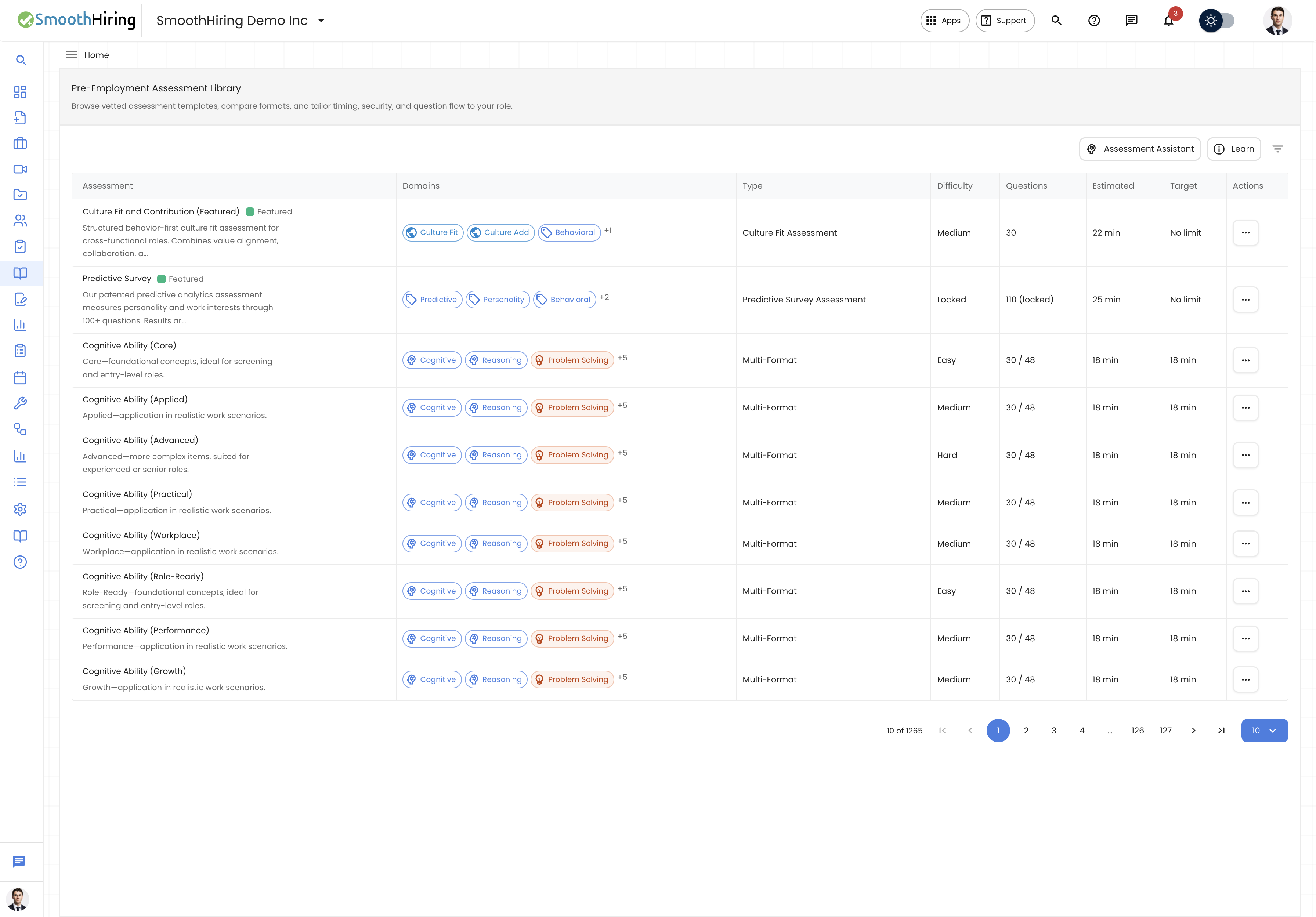
Predictive Survey Assessment
The Predictive Survey is a behavioral questionnaire that measures personality traits relevant to job performance. It uses a validated set of locked questions and a standardized scoring methodology.
Key characteristics:
- Locked question set — questions cannot be modified to preserve scoring validity
- Untimed — no enforced time limit (time is tracked automatically)
- Locked configuration — difficulty, question count, and timing settings cannot be changed
- Role-specific fit — results are evaluated against the requirements of the specific job
Culture Fit Assessment
Culture Fit assessments measure how well a candidate's values, behaviors, and work style align with your organization's culture.
Key characteristics:
- Calibrated scoring — based on benchmarks set by your organizational raters
- Locked configuration — all settings are locked to preserve calibrated scoring integrity
- Dimension-based — measures multiple culture dimensions independently
- Benchmark comparison — candidate scores are compared against organizational benchmarks
Predictive Survey Results
Role Fit Summary
When viewing a completed Predictive Survey from an applicant's Assessments tab, the Predictive Survey Summary section displays:
Fit Level
A color-coded chip indicating overall role fit:
| Fit Level | Description |
|---|---|
| Strong | High alignment with role expectations |
| Good | Solid alignment with minor gaps |
| Fair | Moderate alignment; review recommended |
| Weak | Low alignment with notable gaps |
Job Fingerprint
A visual radar/spider chart showing:
- Multiple job dimensions radiating from the center
- Job requirements mapped as the outer boundary
- Candidate profile overlaid on the same axes
- Visual overlap — the degree of match between requirements and the candidate's profile
The fingerprint chart provides an intuitive visual summary of how well the candidate's assessed traits map to the job's needs.
Personality Traits Bar Chart
A horizontal bar chart displaying each measured personality trait:
- Trait name — the specific personality dimension (e.g., Conscientiousness, Agreeableness, Emotional Stability)
- Candidate score — the individual's score on this trait
- Cohort average — the average score across all candidates who took the same survey (displayed as a reference line)
Traits where the candidate scores significantly above or below the cohort average are the most informative for hiring decisions.
Culture Fit Results
When viewing a completed Culture Fit assessment, the Culture Fit Summary section displays:
Score Components
| Metric | Description |
|---|---|
| Overall Culture Fit Score | Aggregate alignment with organizational culture (numerical) |
| Contribution Score | How much the candidate would contribute to and enhance the culture |
| Culture Fit Band | Categorical label (e.g., "Strong Alignment", "Moderate Alignment") |
| Benchmark Alignment Score | How well the candidate's responses align with calibrated organizational benchmarks |
| Benchmark Alignment Band | Categorical label for the benchmark alignment level |
| Calibration Confidence | Confidence level based on the number of organizational raters who established benchmarks |
| Calibration Rater Count | The number of raters who contributed to the benchmark calibration |
Culture Dimensions
Individual scores are displayed for each culture dimension measured (up to 8 dimensions shown):
- Each dimension receives an independent score
- Dimensions are labeled with clear, descriptive names
- Scores indicate the candidate's position on that cultural spectrum
Benchmark Dimensions
When organizational benchmarks exist, a comparison view shows:
- Candidate score vs. Target benchmark for each dimension
- Gap — the difference between the candidate's score and the target (positive or negative)
- Alignment labels — descriptive text for each dimension comparison
Interpreting Results
Reading Trait Scores
- Above cohort average — the candidate shows stronger-than-typical expression of this trait. May be positive or negative depending on the role requirements.
- At cohort average — typical performance on this dimension
- Below cohort average — weaker expression of this trait. Context matters — some roles benefit from lower scores on certain traits.
Understanding Fit Levels
- Strong Fit does not guarantee job success — it indicates the candidate's assessed profile is highly aligned with the role's predictive model
- Weak Fit does not mean the candidate is unqualified — it suggests the assessed trait profile diverges significantly from the typical success profile for this role
- Fair Fit is the most common outcome and should prompt additional evaluation rather than automatic decisions
Distortion Flags
If a candidate's response patterns appear inconsistent or suggest social desirability bias (answering what they think is "correct" rather than honestly), the fit level may show as Distortion. This indicates:
- Response patterns may be unreliable
- The candidate may have tried to game the assessment
- Consider re-assessing or relying on other evaluation methods
Shared Report Integration
Personality and job fit data are included in the Shared Report that can be generated for each candidate:
Overview Section
The report overview includes the fit level chip and a summary of the candidate's overall alignment with the role.
Job Fit Section
Detailed comparison of:
- Role requirements vs. candidate qualifications
- Education requirements matching
- Skills and experience alignment
Personality Traits Section
A visual bar chart of all measured traits with cohort comparisons, suitable for sharing with hiring managers who may not have platform access.
Job Fingerprint Section
The radar chart showing job requirement vs. candidate profile overlap.
Best Practices
For Predictive Surveys
- Use for roles with established success profiles — the predictive model is most accurate when it can reference historical data about what makes candidates successful in similar roles
- Combine with skills assessments — personality traits predict behavioral tendencies, while skills assessments measure current capabilities
- Don't over-index on a single trait — consider the full trait profile, not just one high or low score
- Review cohort averages — a score that looks average in isolation may be above or below average compared to the candidate pool
For Culture Fit
- Calibrate with diverse raters — the more raters who contribute to benchmarks, the higher the confidence score and the more reliable the comparison
- Review dimension-level data — aggregate scores can mask significant misalignment on individual dimensions
- Consider culture add vs. culture fit — sometimes a candidate who differs from the current culture brings valuable new perspectives