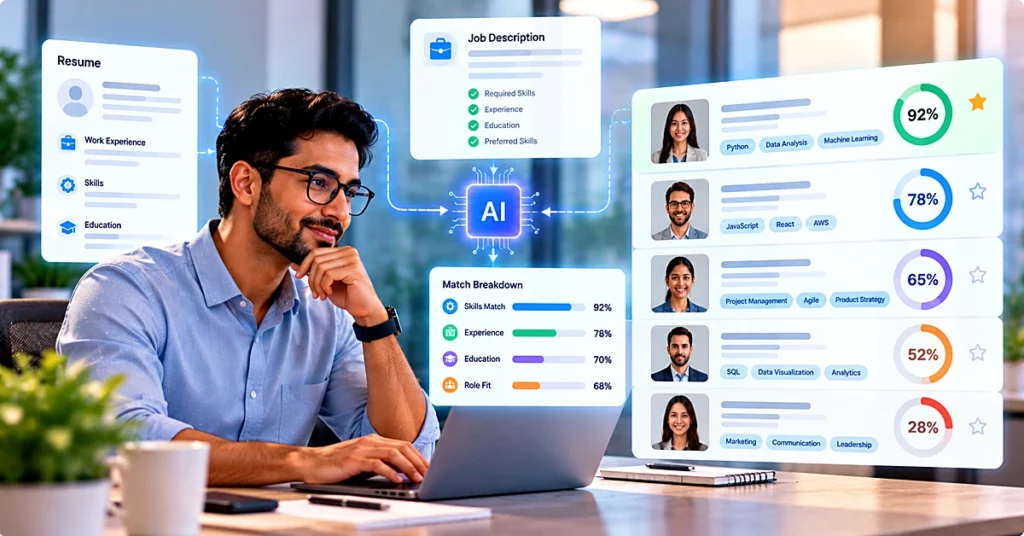



AI resume screening now touches almost every hiring process at scale. Harvard Business School and Accenture’s widely cited 2021 research found that more than 90% of employers use some form of automated system to make a first cut or rank applicants. What that research also found is less flattering: 88% of those same employers admitted their own systems reject qualified, high-skilled candidates simply because a resume didn’t match the exact language of the job description.
This guide explains how AI resume screening actually works, step by step, and where it genuinely fails, including the failure modes vendors rarely put in their marketing copy. The goal isn’t to argue AI screening is broken or that it’s infallible. It’s to explain precisely enough that a recruiter or hiring leader evaluating this technology knows what they’re actually buying.
Key Takeaways
AI resume screening and keyword screening are related, not identical. AI adds semantic matching and scoring on top of keyword logic, but it doesn’t remove the underlying dependency on human-defined criteria.
Most documented screening failures trace back to criteria, not the algorithm itself. Research on “hidden workers” found the core problem is overly rigid, poorly written job requirements applied at scale, not autonomous AI decision-making.
Formatting failures are a distinct, well-documented technical problem. Tables, multi-column layouts, and decorative fonts can cause a parser to scramble or drop resume content entirely, independent of a candidate’s actual qualifications.
The fix isn’t abandoning AI screening. It’s building better criteria, keeping a human in the review loop, and treating an AI score as one input rather than an automatic decision.
What Is AI Resume Screening?
AI resume screening is the use of machine learning and natural language processing to extract information from resumes, compare that information against job requirements, and produce a score or ranking that helps recruiters prioritize which candidates to review first. It builds on traditional keyword-based screening by adding semantic understanding, the ability to recognize that “JavaScript developer” and “front-end engineer with JS experience” may describe a similar candidate, rather than relying on an exact text match alone.
AI Resume Screening vs. Traditional Keyword-Based Screening
The two approaches share the same basic goal, filtering a large applicant pool down to a manageable shortlist, but differ in how they get there.
| Traditional Keyword Screening | AI Resume Screening | |
| How it matches | Literal keyword or Boolean string matching | Semantic matching that can recognize related terms and context |
| Handles synonyms | No, “JS” and “JavaScript” may not match | Often, though not always reliably |
| Output | Pass/fail or simple keyword count | A weighted score and ranked candidate list |
| Main weakness | Misses relevant candidates who phrase things differently | Can appear more objective than it is, masking the same rigid criteria underneath |
| Still requires | Manual keyword list maintenance | Human-defined criteria and ongoing oversight, it doesn’t remove that dependency |
The practical distinction matters less than it might seem. A more sophisticated matching engine still produces bad outcomes if it’s evaluating candidates against the same overly rigid, poorly written criteria that caused traditional keyword screening to fail. AI changes how the filtering happens. It doesn’t automatically fix what’s being filtered for.
How AI Resume Screening Actually Works
Most AI resume screening tools follow the same five-stage process, whether the underlying technology is a modern ATS, a standalone screening product, or a matching feature built into a broader recruiting platform.
Step 1: Resume Parsing and Information Extraction
The system converts an uploaded resume, typically a PDF or Word document, into structured data: name, contact information, work history, education, skills, and dates. This step relies on the system correctly interpreting the document’s layout, which is also where a large share of technical failures originate, covered in detail below.
Step 2: Job Requirement Analysis
The system processes the job description to identify the criteria a candidate will be evaluated against, required skills, years of experience, education level, and sometimes softer requirements like industry background. This step is entirely dependent on how well the job description itself was written, which is a human input, not an AI one.
Step 3: Candidate-Job Matching
The extracted resume data is compared against the parsed job requirements. Modern systems typically use semantic matching here, attempting to recognize related skills and equivalent experience rather than requiring an exact text match, though the sophistication of this matching varies significantly between vendors.
Step 4: Scoring and Ranking
Candidates receive a numerical score or fit rating based on how closely their profile matches the job requirements, and the applicant pool is ranked accordingly. This is the step that turns a qualitative judgment into a quantitative one, which is efficient, but also where nuance most easily gets lost.
Step 5: Recruiter Review
In a well-designed process, a recruiter reviews the ranked shortlist, not just the top score, and makes the actual advancement decision. In practice, this step is also the one most likely to get skipped or rushed under volume pressure, which is where several of the failure modes below actually cause damage.
Where AI Resume Screening Fails
Some of these failures are technical. Others are a direct result of how the system gets configured and used. Both categories matter, and they require different fixes.
Formatting and Parsing Failures
Tables, multi-column layouts, text boxes, and decorative fonts can cause a parser to misread a resume’s structure entirely. A two-column layout is commonly serialized left-to-right, row by row, which can mix unrelated content from different columns into a single unreadable block. A skills table can lose its row-and-column structure completely, becoming a disconnected string of words. Headers and footers containing contact information can be skipped altogether. None of this reflects a candidate’s actual qualifications. It reflects whether their document’s underlying structure happens to match what the parser expects.
Missing or Misleading Resume Information
A parser can only extract what’s actually on the page in a format it can read. A candidate who describes a skill implicitly, through a project description rather than a listed keyword, may score lower than a less-qualified candidate who happened to list the exact term the system was configured to look for.
Keyword Limitations and Rigid Job Requirements
This is the failure mode the Harvard Business School and Accenture research documented most clearly. Lead researcher Joseph Fuller cited real examples: hospitals scanning nurse resumes for “computer programming” when the actual need was comfort entering patient data into a system, power companies requiring customer-service background to hire people who repair electrical lines, and retail candidates rejected for lacking “floor-buffing experience.” These aren’t AI errors in the sense of a broken algorithm. They’re rigid, overly specific criteria, written by people, executed unquestioningly at scale.
Non-Traditional Career Paths and Career Changers
Screening systems are typically configured around a linear career narrative: consistent job titles, no gaps, a clear progression within one field. A candidate changing careers, returning after a caregiving break, or building a career from military service or self-employment often doesn’t fit that template, regardless of actual capability.
Transferable Skills That Don’t Match Keywords
A project manager moving from construction into software delivery has directly relevant skills, stakeholder management, scheduling, risk tracking, but a resume built around construction terminology may not surface those skills to a system looking for software-specific keywords, even a semantically aware one.
False Positives and False Negatives
A false positive is a poorly suited candidate who scores well because their resume happens to contain the right terms without the underlying substance. A false negative is a genuinely qualified candidate the system ranks low or filters out entirely, the core problem the hidden workers research describes at scale. Vendors tend to advertise accuracy in aggregate; the two error types have very different costs and are rarely broken out separately in marketing claims.
Bias in Training Data and Screening Criteria
A system trained on historical hiring patterns, or configured with criteria that correlate with protected characteristics even indirectly, such as employment gaps or graduation dates, can reproduce those patterns at scale. This is a documented risk, not a hypothetical one, and it’s precisely why screening tools that qualify as automated employment decision tools face growing regulatory scrutiny, including independent bias audit requirements in some jurisdictions.
Over-Reliance on AI Scores and Lack of Human Oversight
The failure mode that ties the others together: a high volume of applicants creates real pressure to trust the ranked list and move on, rather than spot-checking candidates the system scored lower. A score is a summary of pattern-matching against defined criteria. It is not a verified judgment of whether someone can do the job.
Why the Problem Is Usually the Criteria, Not the AI
It’s worth being precise here, since this distinction gets lost in most coverage of this topic. The hidden workers research doesn’t conclude that automated screening software autonomously discriminates against candidates. It concludes that companies configure their screening systems with criteria, exact keyword requirements, zero tolerance for employment gaps, degree requirements attached to roles that don’t need one, that are frequently disconnected from what the job actually requires. The software then executes those instructions consistently and at a scale no team of human reviewers could match.
That reframing matters because it points to a fixable problem. A better algorithm alone doesn’t solve criteria that were wrong to begin with. Better-defined criteria, reviewed periodically against actual job performance, does.
How to Reduce AI Resume Screening Failures
Audit job requirements before they’re fed into the system. Distinguish genuinely required qualifications from a wish list of nice-to-haves, since every additional rigid requirement is another way to filter out a qualified candidate.
Use parser-friendly application formats where possible. Or, better, evaluate screening tools on how well they handle formatting variation rather than assuming every candidate will submit a perfectly parser-optimized document.
Review a sample of rejected candidates periodically, not just the top-ranked shortlist, to catch systematic false negatives before they become a pattern.
Weight skills and demonstrated ability alongside keyword matches. A matching system built around role-specific competencies, not just resume text, catches transferable skills a pure keyword approach misses.
Keep a human reviewing the full ranked list, not only the top scores. The recruiter review step is where most of these failure modes get caught, if it’s actually built into the process rather than skipped under volume pressure.
Platforms built around structured, transparent matching criteria, rather than an opaque score, make this easier to manage in practice. SmoothHiring’s smart candidate matching is built around this principle: scoring candidates against the specific competencies a role requires, with the reasoning visible to the recruiter rather than hidden inside a black-box ranking.
Frequently Asked Questions
Is AI resume screening accurate?
Is AI resume screening accurate?
Accuracy depends heavily on how the system is configured, not just the underlying technology. Research on automated hiring systems has found that 88% of employers believe their own screening tools reject qualified candidates due to overly rigid criteria, which is a configuration problem as much as a technical one.
How is AI resume screening different from an ATS?
An applicant tracking system, or ATS, is the broader platform that manages job postings, applications, and hiring workflow. AI resume screening is typically one feature within an ATS, or a specialized layer added to it, focused specifically on parsing, scoring, and ranking candidates.
Can AI resume screening be biased?
Yes. A system trained on historical hiring data, or configured with criteria that correlate indirectly with protected characteristics, can reproduce those patterns at scale. This is a documented, real risk, which is why independent bias auditing has become a legal requirement for automated hiring tools in some jurisdictions.
Why do qualified candidates get rejected by AI screening?
Most commonly because their resume’s formatting caused a parsing error, their experience was described in different terms than the system was configured to match, or the job requirements themselves were too rigid, requiring an exact credential or keyword match rather than reflecting what the role actually needs.
Should recruiters trust AI resume screening scores?
A score is useful as a starting point for prioritization, not as a final decision. Reviewing candidates beyond the top-ranked group, and treating the score as one input alongside human judgment, catches qualified candidates the system may have under-ranked.
Conclusion
AI resume screening genuinely helps recruiting teams manage volume that would otherwise be unmanageable. It also, reliably and at scale, filters out qualified candidates when the underlying criteria are too rigid, the resume format doesn’t parse cleanly, or nobody’s reviewing what the system ranked low. Neither half of that is a reason to abandon the technology. Both halves are reasons to use it with clear eyes about what it’s actually doing.
If you’re evaluating how well your own screening process balances speed with accuracy, it’s worth looking at how the underlying applicant tracking system itself is built, since screening quality depends as much on the platform’s structure as on any single AI feature sitting on top of it.