
How do you audit AI hiring tools for bias? In short: inventory every AI-driven tool used in hiring, map which decisions it influences, review the vendor’s documentation and validation evidence, test selection rates across demographic groups using accepted statistical screens like the four-fifths rule, and document findings with a remediation and re-testing plan — ideally with input from qualified legal and statistical reviewers, since this is a compliance-adjacent process, not a one-time checkbox.
Interest in AI recruiting tools has outpaced the regulatory and research infrastructure meant to keep them accountable. A resume-screening algorithm, a video-interview scoring model, or a candidate-matching system can each introduce or amplify bias without anyone intending it, simply because of what data trained it or what proxy signals it relies on. The legal landscape governing these tools is also unusually unsettled right now: federal guidance has been pulled back even as several states have moved in the opposite direction. This guide walks through where bias tends to enter AI-driven hiring, how to run a practical audit, and what the current patchwork of U.S. law and voluntary frameworks actually requires as of this article’s publication date, since this area is changing quickly enough that a reader should verify current status before relying on any of it.
What AI Hiring Bias Is, and How It Happens
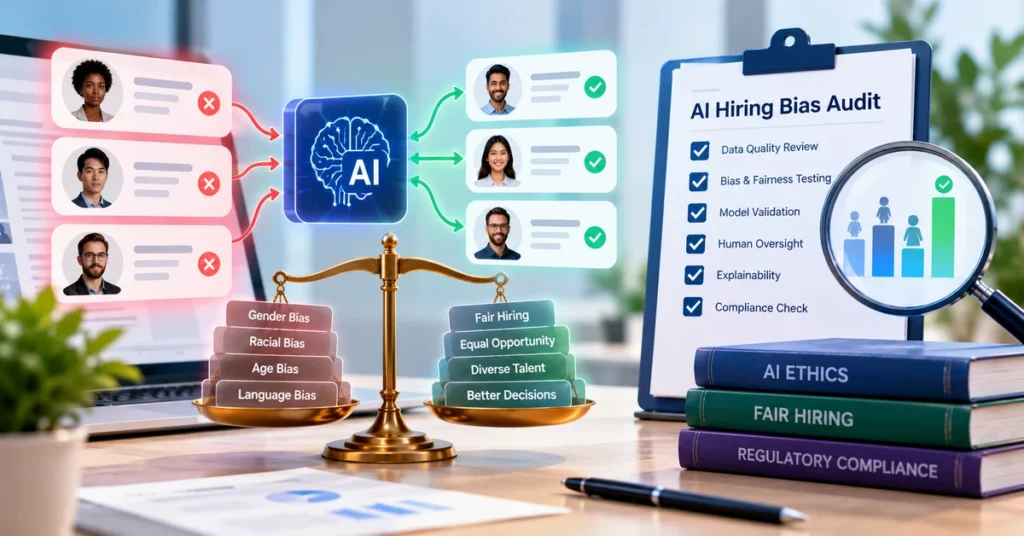
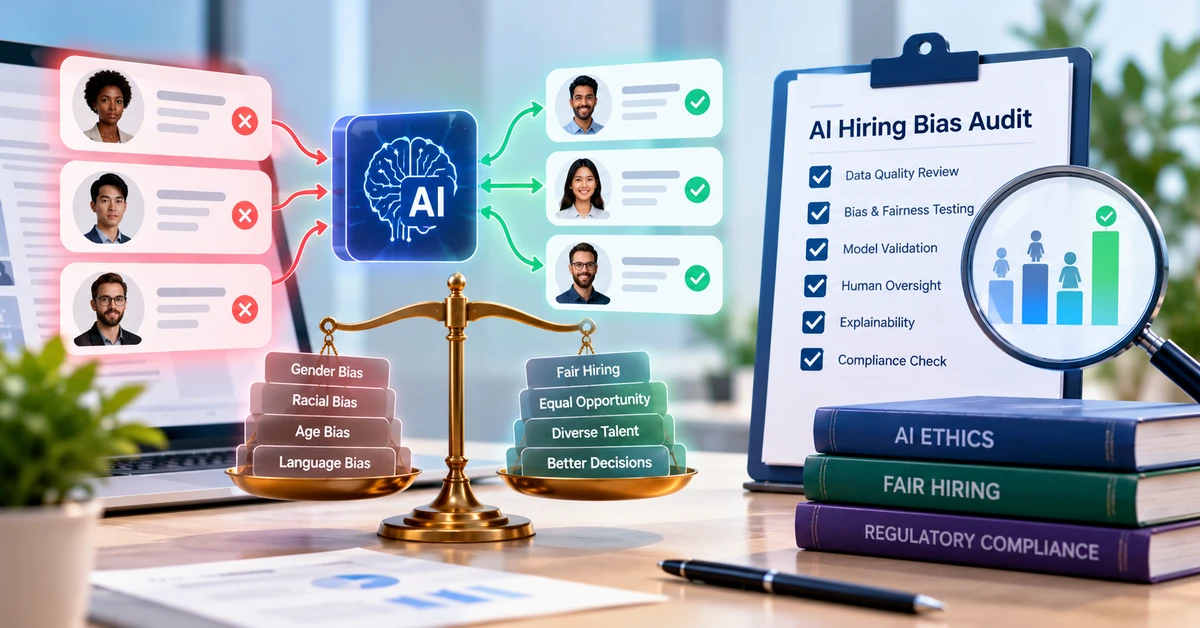
AI hiring bias is a systematic difference in how an AI-driven tool scores, ranks, or screens candidates that correlates with a protected characteristic — race, sex, age, disability, national origin, or another legally protected trait — rather than with job-relevant qualifications. It doesn’t require intent. A tool can produce biased outcomes even when no one involved in building or deploying it meant for that to happen, because the bias is usually baked into the data the tool learned from or the proxy variables it relies on.
This differs from traditional hiring bias in degree, not kind. A biased human recruiter affects the candidates that recruiter personally screens. A biased algorithm can apply the same pattern to every resume it touches, at a scale and consistency no individual reviewer could match — which is exactly why a flawed model is harder to catch informally, and why a structured audit process matters more here than it does for one hiring manager’s habits.
Where Bias May Enter the Hiring Process
Bias can enter at several distinct points, and a useful audit checks each one rather than assuming a single test covers the whole system:
Training data — if the historical hires a model learned from skew toward one demographic group, often a byproduct of a company’s own past hiring patterns, the model can learn to reproduce that skew rather than correct for it.
Resume screening — keyword-matching and embedding-based screeners can pick up proxy signals correlated with race, gender, or age, including school names, addresses, employment gaps, or first names. A 2025 study by researchers at the University of Washington and University of Washington Information School, published via the AAAI/ACM AIES conference and summarized by the Brookings Institution, simulated AI resume screening across nine occupations and found white-associated names were preferred over Black-associated names in 85.1% of comparisons, and men’s names were favored over women’s names 51.9% of the time versus 11.1%; disparities were largest for candidates at the intersection of race and gender.
Candidate ranking and matching — tools that rank applicants against a “top performer” profile can encode whatever biases shaped who became a top performer in the first place.
Automated assessments — a personality or cognitive test validated on one population may not generalize to another, and can disadvantage candidates with disabilities if it wasn’t designed with accessibility in mind.
Video interview analysis — tools that infer traits from facial expression, tone, or word choice carry added risk: researchers have raised validity questions about whether these signals reliably predict job performance at all, separate from fairness concerns, and such tools can disadvantage candidates with speech, vision, or motor disabilities, non-native English speakers, or people using accommodations.
Historical hiring decisions — using past accept/reject outcomes as a training label bakes in whatever bias, conscious or not, shaped those past decisions.
Proxy variables and accessibility barriers — zip code (correlated with race), graduation year (correlated with age), and employment gaps (correlated with disability or caregiving responsibilities) can all function as indirect discrimination vectors even when the protected characteristic itself is never a direct input; an interface that isn’t screen-reader compatible is a barrier before scoring even begins.
Distinguishing Automation From Validated, Fair Decision-Making
Not every automated step is a fairness risk, and not every validated tool stays fair forever. The distinction that matters is whether a tool’s outputs have been tested against actual job performance and checked for disparate outcomes across groups — what personnel-selection researchers call validation — versus a tool that simply runs faster than a human reviewer without that evidence behind it. A fast, consistent process is not the same as a fair or accurate one; speed and consistency can scale a flawed pattern just as easily as a good one. A tool is on firmer ground when a vendor can show validity evidence tied to actual job performance, adequate sample sizes behind that evidence, and periodic re-testing as the applicant pool or the tool itself changes — not just a one-time study from when the product launched.
A Step-by-Step Framework for Auditing AI Hiring Tools
Inventory AI tools and their intended uses — list every tool touching hiring (screening, ranking, assessment, video analysis, any scoring inside scheduling) and what it’s supposed to do.
Map the hiring stages and decisions it influences — identify exactly which decision each tool feeds (advance, reject, rank order, interview score) and who can override it.
Review vendor documentation and model limitations — request validation studies, intended-use statements, and known limitations; a vendor unwilling to share this is itself a signal.
Assess data quality and representativeness — check whether training and validation data reflects the applicant population the tool is screening now, not just the population it was built on.
Define comparison groups and job-related outcomes — decide which groups (race, sex, and their intersections, at minimum) and which outcome (advance to interview, assessment score, final selection) the test will measure.
Test selection rates and potential adverse impact — compare selection rates across groups using an accepted statistical screen (see the worked example later in this document).
Review error rates and accessibility concerns — check for differential error rates by group and whether the tool has been tested for accessibility.
Document findings, remediation, and follow-up testing — record what was tested, what was found, what changed as a result, and when it will be tested again.
Interpreting Selection-Rate Comparisons: The Four-Fifths Rule
The most commonly used screening tool for adverse impact comes from the Uniform Guidelines on Employee Selection Procedures (UGESP), a 1978 federal regulation still in force at 29 C.F.R. Part 1607. Under Section 1607.4(D), a selection rate for any race, sex, or ethnic group that is less than four-fifths (80%) of the rate for the group with the highest selection rate “will generally be regarded by the Federal enforcement agencies as evidence of adverse impact.”
That phrasing matters: UGESP treats this as a screening indicator, not an automatic finding of illegal discrimination. The guidelines also note that a gap smaller than four-fifths may not count as adverse impact if the sample is too small to be statistically meaningful, and a gap larger than four-fifths can still be flagged if it’s both statistically and practically significant. In practice, the four-fifths ratio is a useful first screen for deciding whether a deeper look is warranted — not a pass/fail test an employer can run once and treat as a final answer. A worked example appears in the table later in this document. Because the legal significance of any result depends on sample size, job-relatedness, and the jurisdiction’s current law, a result outside — or inside — the four-fifths range should be reviewed with qualified legal and statistical counsel before any conclusion is drawn.
Human Oversight, Accommodations, Transparency, and Appeals
A fairness audit is a point-in-time check; human oversight is what keeps a tool accountable between audits. That means a person with the authority to override an AI-driven recommendation, not just review it after the decision is already final, and a clear record of when and why an override happened.
AI-driven assessment or video interview, consistent with ADA reasonable-accommodation principles, and that path should be easy to find, not buried in fine print. Transparency — telling candidates an AI tool is being used and, where legally required, giving advance notice — is both a growing legal requirement in several jurisdictions and a credibility signal on its own. An appeals or reconsideration process, even an informal one, gives a way to catch errors a statistical audit might miss, particularly the kind of individual-level mistake that a selection-rate comparison across an entire applicant pool wouldn’t surface.
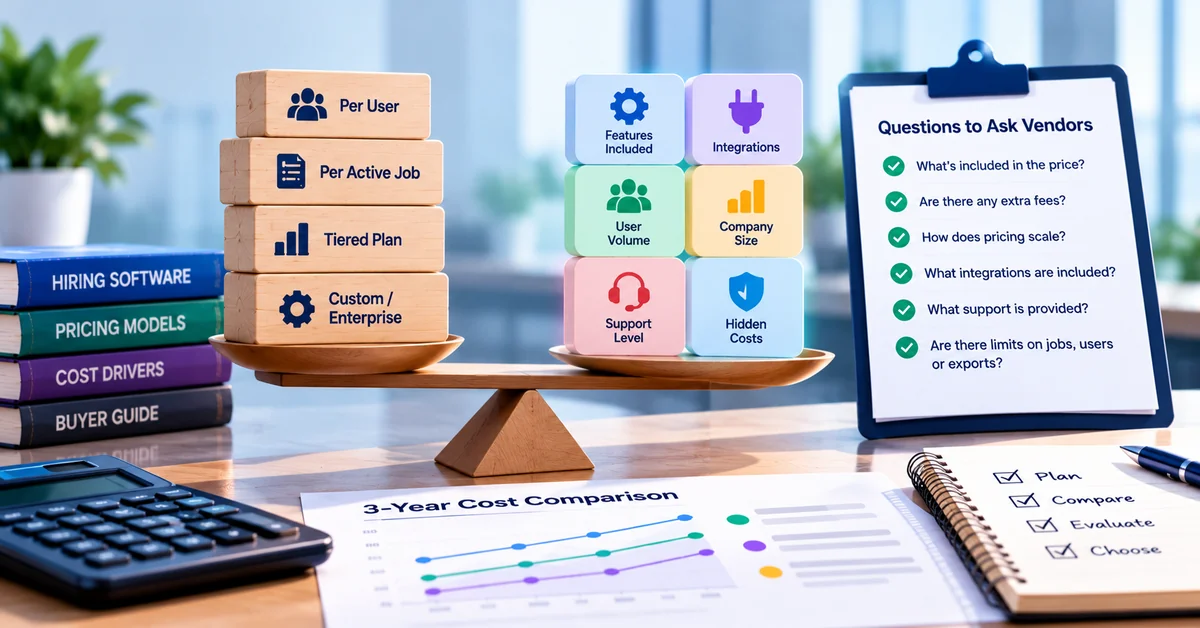
Questions to Ask AI Recruiting Vendors
1. What data was the model trained and validated on, and how closely does it match our applicant population?
2. Can you share validation study results, including sample sizes and the demographic groups tested?
3. Has the tool been independently audited for bias, and can you share the auditor’s identity and methodology, not just a summary?
4. What is the tool’s documented intended use, and what uses does the vendor explicitly caution against?
5. How are error rates and selection rates monitored over time, and how often is the tool re-validated?
6. What accessibility accommodations exist for candidates with disabilities?
7. What human-override capability exists, and is it built into the product or something we have to build ourselves?
8. Who is liable if the tool produces a disparate impact — does the contract address this, and has it been reviewed by counsel?
How Often to Review, and What to Do When Bias Is Identified
Re-test at least annually, and sooner after any material change: a new vendor version, a materially different applicant pool (a new market, a new role type), or a regulatory change in a jurisdiction where the company hires. NYC’s Local Law 144, for example, requires an independent bias audit within the 12 months before an automated tool is used and annually after that for as long as it’s in use — a reasonable floor even for employers outside NYC’s jurisdiction.
If a selection-rate comparison or another test flags a potential issue, the responsible next step isn’t to quietly stop running the number — it’s to investigate the cause (data, feature selection, sample size), consult legal counsel before making any public statement about the finding, consider pausing the tool for the affected population while the issue is investigated, and document the whole process. A flagged result that’s addressed and documented is a materially different risk position than the same result left unexamined.
Common Auditing Mistakes and Limitations
The most common mistake is treating a single four-fifths calculation as proof a tool is fair. It isn’t — sample size, intersectional effects (the research cited above found the largest disparities only appeared when race and gender were analyzed together, not separately), and job-relatedness all affect whether a ratio means anything. A second mistake is auditing a tool once at launch and never again, even as the applicant pool, the model, or the law changes under it. A third is treating “the vendor says it’s fair” as sufficient evidence without requesting the underlying validation data.
The audit process itself has real limits. It can only test what it measures, so a characteristic or an intersectional effect nobody thought to check can pass undetected. Statistical significance depends on having enough hires or applicants in each group to begin with, which many SMB-scale hiring volumes may not reach for every role. And no audit, however well run, substitutes for a qualified attorney’s read on an organization’s specific legal exposure.
Where Recruiting Technology Fits
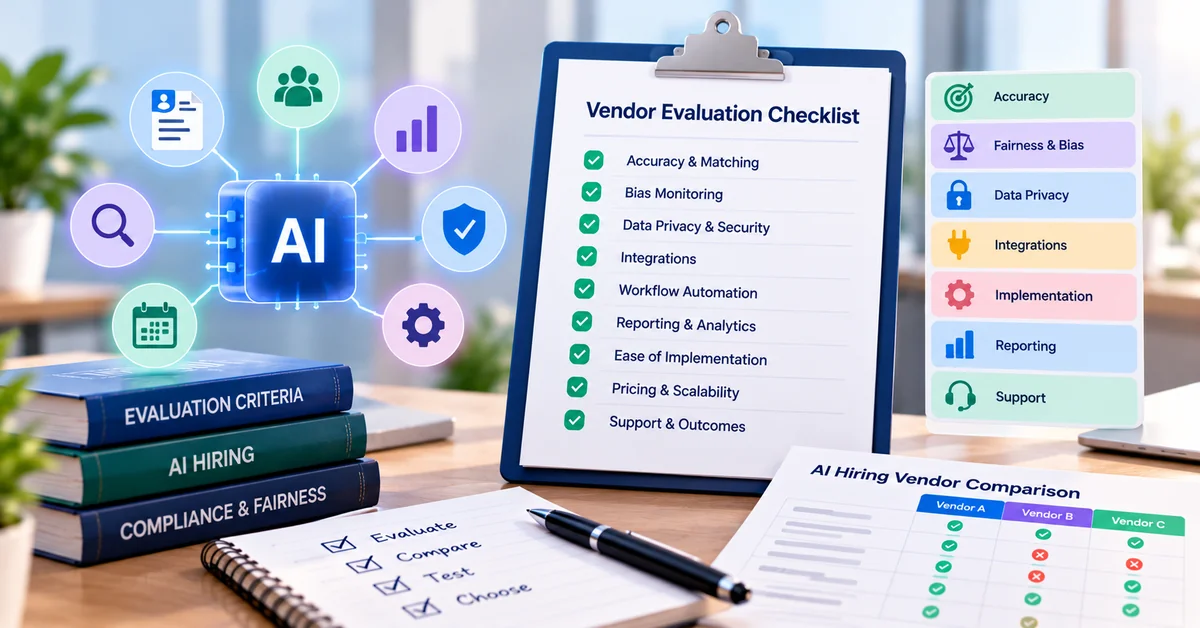
Evaluating a recruiting platform for fairness means asking the same questions listed above of any vendor, including the one supplying your core hiring software. SmoothHiring’s AI hiring platform documents several bias-mitigation features — blind initial screening that removes or deprioritizes name, graduation year, and address; standardized assessments and structured interview kits; and training data the product page says is periodically reviewed for representation across gender, ethnicity, geography, and background. Treat these as documented product features to evaluate against the framework above, not as a substitute for running your own audit: the page does not publish independent audit results, a named auditor, or a bias-reduction figure backed by a cited, verifiable study, and no AI recruiting vendor, including SmoothHiring, should be treated as having passed a formal bias audit unless that evidence is independently verifiable. An applicant tracking system that logs every stage a candidate moves through also makes pulling the selection-rate data this audit process needs far less manual than reconstructing it after the fact.
Next Steps
AI hiring bias isn’t a one-time risk to clear off a list — it’s an ongoing property of a system that changes as the tool, the applicant pool, and the law around it all keep moving. The practical version of fairness is procedural: know what tools are running, test them on a schedule, keep a human in the loop with real override authority, and document the process well enough that it would hold up to outside scrutiny. None of that guarantees a tool is unbiased. It’s what responsible oversight looks like while the legal and technical standards keep evolving.
AI Hiring Fairness Audit Checklist
Inventory every AI-driven tool used anywhere in hiring (screening, ranking, assessment, video analysis, scheduling with scoring) and its documented intended use
Map which hiring decisions each tool influences and confirm a human can override each one
Request and review vendor validation documentation, including sample sizes and demographic groups tested
Assess whether training/validation data reflects your current applicant population
Define comparison groups (race, sex, and intersections, at minimum) and the job-related outcome being measured
Calculate selection rates by group and apply the four-fifths screen (see worked example)
Review error rates by group and test the tool’s accessibility (e.g., screen-reader compatibility)
Confirm a documented accommodation and appeals path exists for candidates
Document findings, remediation taken, and the date of the next scheduled re-test
Confirm current legal requirements for every jurisdiction where you hire, since state and local AI-hiring laws differ and change frequently
Review findings with qualified legal counsel before drawing conclusions or making public statements
Practical Audit Table
Audit Area What to Examine Evidence to Collect Potential Warning Signs Recommended Action Tool inventory & intended use Every AI/automated tool touching hiring and its stated purpose Vendor contracts, system list, intended-use documentation Tools in active use that no one can fully account for (“shadow AI”) Build and maintain a living inventory; flag any undocumented tool for immediate review Hiring-stage mapping Which decisions (advance, reject, rank, score) each tool influences, and who can override Process maps, decision logs A tool effectively making final decisions with no human-review step Insert a documented human-review checkpoint at every stage a tool influences Vendor documentation & limitations Validation studies, intended-use statements, known limitations Vendor-provided validation reports, contract language Vendor can’t produce validation data, or offers marketing claims instead of a study Require validation documentation in the contract; treat refusal as a vendor-selection risk factor Data quality & representativeness Whether training/validation data reflects the current applicant population Data-source documentation; demographic breakdown of training data vs. current applicants Training data drawn from a narrow or outdated population; no documented provenance Request a representativeness review before deployment and after major applicant-pool shifts Comparison groups & outcomes Which groups and outcomes the fairness test will measure Defined test plan; job-relatedness rationale for the outcome measured Only single-axis comparisons (race OR sex, never intersectional) Include intersectional comparisons, not only single-characteristic ones Selection-rate / adverse-impact testing Selection rates by group against the four-fifths screen Selection-rate calculations, sample sizes, statistical-significance testing A group’s rate below 80% of the highest group’s rate; sample too small to interpret confidently Investigate flagged gaps with a qualified statistician; don’t rely on the ratio alone Error rates & accessibility Differential error rates by group; accessibility of the tool itself Error-rate breakdowns by group; accessibility testing results Materially different error/false-reject rates by group; no accommodation path Build and publicize an accommodation request process; fix accessibility gaps before continued use Documentation, remediation & follow-up A record of findings, actions taken, and the next test date Written audit report, remediation plan, re-test calendar Findings exist but no action was taken or documented Set a mandatory re-test cadence (at least annually); assign clear ownership for remediation
Hypothetical Selection-Rate Example (Illustrative Only)
| Audit Area | What to Examine | Evidence to Collect | Potential Warning Signs | Recommended Action |
|---|---|---|---|---|
| Tool inventory & intended use | Every AI/automated tool touching hiring and its stated purpose | Vendor contracts, system list, intended-use documentation | Tools in active use that no one can fully account for (“shadow AI”) | Build and maintain a living inventory; flag any undocumented tool for immediate review |
| Hiring-stage mapping | Which decisions (advance, reject, rank, score) each tool influences, and who can override | Process maps, decision logs | A tool effectively making final decisions with no human-review step | Insert a documented human-review checkpoint at every stage a tool influences |
| Vendor documentation & limitations | Validation studies, intended-use statements, known limitations | Vendor-provided validation reports, contract language | Vendor can’t produce validation data, or offers marketing claims instead of a study | Require validation documentation in the contract; treat refusal as a vendor-selection risk factor |
| Data quality & representativeness | Whether training/validation data reflects the current applicant population | Data-source documentation; demographic breakdown of training data vs. current applicants | Training data drawn from a narrow or outdated population; no documented provenance | Request a representativeness review before deployment and after major applicant-pool shifts |
| Comparison groups & outcomes | Which groups and outcomes the fairness test will measure | Defined test plan; job-relatedness rationale for the outcome measured | Only single-axis comparisons (race OR sex, never intersectional) | Include intersectional comparisons, not only single-characteristic ones |
| Selection-rate / adverse-impact testing | Selection rates by group against the four-fifths screen | Selection-rate calculations, sample sizes, statistical-significance testing | A group’s rate below 80% of the highest group’s rate; sample too small to interpret confidently | Investigate flagged gaps with a qualified statistician; don’t rely on the ratio alone |
| Error rates & accessibility | Differential error rates by group; accessibility of the tool itself | Error-rate breakdowns by group; accessibility testing results | Materially different error/false-reject rates by group; no accommodation path | Build and publicize an accommodation request process; fix accessibility gaps before continued use |
| Documentation, remediation & follow-up | A record of findings, actions taken, and the next test date | Written audit report, remediation plan, re-test calendar | Findings exist but no action was taken or documented | Set a mandatory re-test cadence (at least annually); assign clear ownership for remediation |
Hypothetical Selection-Rate Example (Illustrative Only)
The scenario, applicant counts, and conclusions below are entirely hypothetical, built only to demonstrate the four-fifths calculation. They are not real audit results, a SmoothHiring finding, or a legal determination of discrimination. Any real result requires review by qualified legal and statistical counsel before any conclusion is drawn.
Scenario: an AI resume-screening tool advances applicants to the interview stage. Out of 200 total applicants in a hypothetical hiring cycle:
| Group | Applicants | Advanced to Interview | Selection Rate |
|---|---|---|---|
| Group A | 100 | 40 | 40% |
| Group B | 80 | 20 | 25% |
| Group C | 20 | 9 | 45% |
Step 1 — Identify the highest selection rate: Group C at 45%.
Step 2 — calculate the four-fifths threshold: 45% × 0.8 = 36%.
Step 3 — compare each group’s rate to that threshold: Group A (40%) is above 36% — no adverse impact flagged under this screen. Group B (25%) is below 36% — in fact, 25% is only about 56% of Group C’s rate (25 ÷ 45), well under the 80% threshold, so this screen flags evidence of adverse impact warranting further investigation.
Step 4 — apply the caveats before concluding anything: Group C’s result is based on only 20 applicants, a small enough sample that its 45% rate is less statistically reliable than Group A’s or B’s — exactly the kind of small-sample situation UGESP itself says agencies may weigh using data over a longer period. A flagged result here is a signal to investigate, not a finding of discrimination on its own.
FAQs
What is AI hiring bias?
A systematic difference in how an AI-driven hiring tool scores, ranks, or screens candidates that correlates with a protected characteristic — such as race, sex, age, or disability — rather than job-relevant qualifications, regardless of whether anyone intended that outcome.
How do you audit an AI hiring tool for bias?
Inventory the tools in use, map the decisions they influence, review vendor validation documentation, assess data quality, define comparison groups, test selection rates (e.g., the four-fifths rule), review error rates and accessibility, and document findings with a remediation and re-test plan.
What is the four-fifths rule?
A screening indicator from the 1978 Uniform Guidelines on Employee Selection Procedures (29 C.F.R. § 1607.4(D)): if a group’s selection rate is less than 80% of the highest-performing group’s rate, that is generally treated as evidence of adverse impact warranting further review — not an automatic legal conclusion.
Does the EEOC require AI bias audits?
No federal rule currently mandates them directly. The EEOC removed its AI-specific technical guidance from its website in January 2025, and its 2026 enforcement plan moved away from pursuing disparate-impact theories; however, Title VII and UGESP remain in force, and private lawsuits and state or local laws can still apply. Verify current status before relying on this.
Is NYC Local Law 144 the only law requiring AI hiring bias audits?
No. As of 2026, California, Illinois, and Texas have each adopted their own automated-hiring rules with different standards and effective dates, and Colorado’s law remains in legal and legislative flux. More jurisdictions are expected to act, so compliance depends on where you hire.
Can an AI hiring tool be certified as unbiased?
No universally recognized certification currently exists. A bias audit is a point-in-time test against specific comparison groups and data — not a permanent guarantee — and should be repeated on a regular schedule.
Does using AI in hiring eliminate human bias?
No. AI can standardize how criteria are applied, but it can also encode and scale whatever bias exists in its training data or design. It isn’t a substitute for human oversight and ongoing review.