


AI in recruitment has moved past the hype cycle. It is now a set of tools that can save real time on narrow tasks, but it also sits inside a regulatory world that has tightened faster than most vendors’ marketing. The gap between what these tools promise and what they do well is where the main risk now lives in 2026.
This guide separates the two. It shows what AI in recruitment can do, what it still cannot do well, and the compliance rules that now apply whether a team has tracked them or not.
Key Takeaways
AI is genuinely good at narrow, well-defined tasks. AI resume screening, scoring structured assessments, and scheduling are mature uses in recruiting.
AI is not good at judgment calls that require context. Culture fit, trade-offs between candidates, and final hiring calls still need a human.
The legal floor has risen sharply. NYC Local Law 144 requires independent audits, public disclosure, and candidate notice for automated employment decision tools, and the EU AI Act classifies recruitment AI as high-risk.
Faster screening does not automatically mean better hiring. Poor criteria can let a team reject candidates faster, not more fairly.
What AI in Recruitment Can Reliably Do
The best uses of AI in recruitment are narrow, rule-based tasks. The criteria are clear, the output is measured, and the system is not being asked to make a judgment call.
Screening at volume. AI can cut the manual work in AI resume screening when the requirements are explicit: a certification, years of experience, or a must-have skill. This remains the most mature use of AI in hiring today.
Scoring structured assessments. If a response has a correct answer or fits a fixed rubric, automated scoring is fast and stable.
Scheduling and status updates. Matching calendars and sending updates is a solved task. It frees recruiters for work that needs judgment.
Ranking against explicit role criteria. When the role is clear and the rules are specific, AI ranking can build a shortlist faster than manual review. The quality of that shortlist still depends on the criteria.
What AI in Recruitment Cannot Reliably Do
AI can reduce manual work, but faster screening does not automatically mean better hiring. Poor matching rules can let an organization reject candidates faster at the same or worse accuracy as a human reviewer. It can feel efficient even when the result is weaker.
Judge nuanced fit. A candidate’s fit with a team’s style depends on context that AI systems do not reliably have.
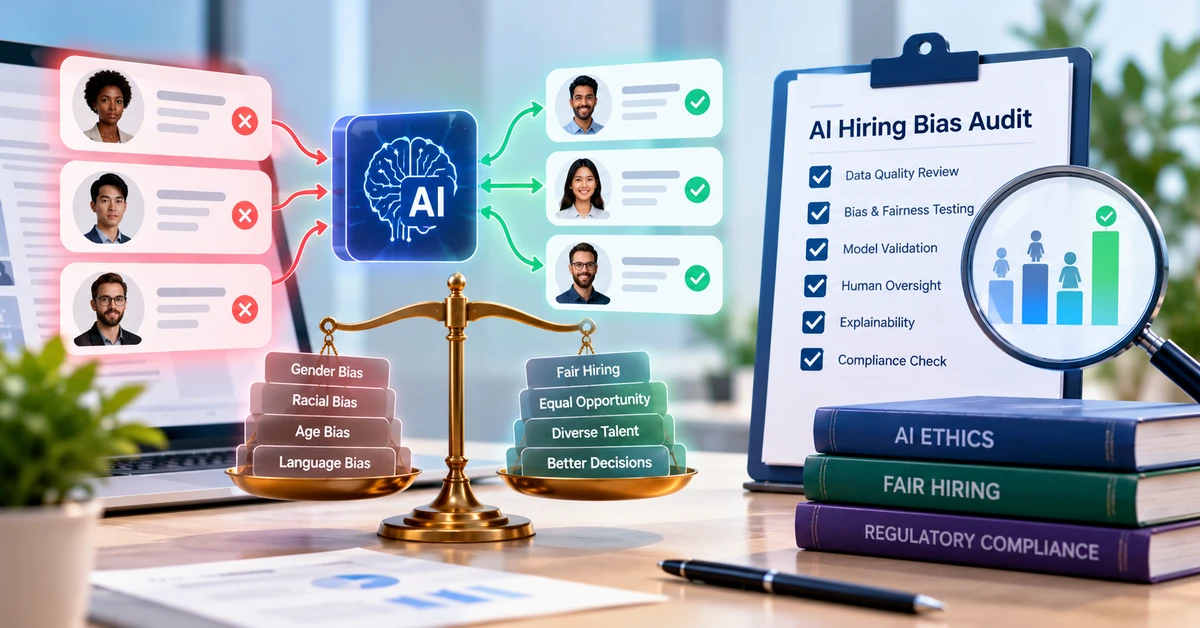
Guarantee an unbiased outcome. An AI system trained on past hiring data can copy the bias in that data. That is why independent audits are central to AI hiring bias checks, not just a nice extra.
Replace the final decision for senior or ambiguous roles. The more a role depends on judgment, strategy, or people dynamics rather than a checklist, the less reliable AI ranking is as the final call.
Explain itself to a regulator’s satisfaction by default. Most AI hiring tools were not built with audit trails or transparency in mind, which creates a real compliance gap under laws that demand that kind of record.
| AI Can Reliably | AI Cannot Reliably |
| Screen large applicant volumes against defined criteria fast | Judge nuanced cultural or team fit without human context |
| Score structured assessments consistently | Guarantee freedom from bias without independent auditing |
| Schedule interviews and automate status updates | Replace a hiring manager’s final judgment call |
| Rank candidates against role-specific criteria | Explain its own reasoning in a way that satisfies a legal audit by default |
| Flag response patterns suggesting low effort or fraud | Fully replace a structured interview for senior or nuanced roles |
Is AI Hiring Legal? The 2026 Compliance Reality
Using AI in hiring is legal, but it now comes with specific, enforceable duties in multiple places. Those duties are the heart of AI hiring compliance, and they attach to the tool, not just to the employer’s internal policy. Two regimes matter most for U.S.-based employers in 2026.
NYC Local Law 144
Effective since July 2023 and still the most enforcement-active AI hiring law in the U.S., Local Law 144 requires an independent bias audit of any automated employment decision tool within the past year, a public summary of that audit, and at least 10 business days’ notice to candidates before the tool is used. It applies based on where the candidate lives, not where the employer is headquartered. So a remote hire living in any of New York City’s five boroughs brings a company into scope, no matter where the company is based. Penalties run $500 to $1,500 per violation, counted per candidate and per day.
The EU AI Act
The EU AI Act classifies AI systems used to recruit, screen, or evaluate candidates as high-risk under Annex III. A 2026 update, the Digital Omnibus on AI, pushed the deadline for high-risk conformity duties to December 2027, but that delay applies only to conformity assessment requirements. The Act’s transparency duties took effect in August 2026 and are already enforceable. Any employer hiring for roles based in the EU falls within scope, no matter where that employer is headquartered.
The State-Level Picture Is Still Moving
Beyond NYC and the EU, state-level AI hiring regulation is still moving, not settled. Colorado’s AI Accountability Act faced a legal challenge that led a federal court to pause enforcement in 2026, and a late-2025 federal executive order has tried to limit state-level AI regulation more broadly, a position already being tested in court. The practical takeaway for a hiring team is not to wait for the law to settle. It is to build responsible AI hiring habits: an audit trail, clear candidate notice, and documented human oversight that meet the strictest current rule, since that approach usually covers most other places by default.
Where Human Oversight Still Matters
The teams getting the most value from AI in recruitment are not the ones that automate the most steps. They are the ones that are precise about which steps stay automated and which ones need a person. Use automation for repetitive, criteria-based work. Keep human judgment for decisions where context, nuance, and accountability matter. That division of labor, more than the tool itself, decides whether AI hiring tools improve outcomes or simply speed up the same mistakes.
Frequently Asked Questions
Can AI replace recruiters?
Can AI replace recruiters?
No, not for the parts of the job that need judgment, relationship building, or nuanced evaluation. AI handles narrow, rule-based tasks like screening and scheduling, but final decisions and complex candidate review still need human involvement.
Is using AI in hiring legal?
Yes, but it comes with real duties in several places. NYC Local Law 144 requires independent bias audits and candidate notice, and the EU AI Act classifies recruitment AI as high-risk, with transparency duties already in force as of August 2026.
Does NYC Local Law 144 apply to companies outside New York?
Yes. If the candidate being evaluated lives in any of New York City’s five boroughs, the law applies no matter where the employer is headquartered or where the job is based.
Can AI hiring tools be biased?
Yes. An AI system trained on historical hiring data can repeat the bias in that data. That is why independent bias auditing is now a legal duty under laws like NYC Local Law 144, not an optional best practice.
What should a hiring team automate versus keep human?
Repetitive, criteria-based tasks like initial screening, assessment scoring, and scheduling are well suited to automation. Final decisions, nuanced fit review, and anything that needs accountability for a specific call should stay with a person.
Conclusion
AI in recruitment in 2026 is neither the recruiter-replacing revolution some vendors promised nor a passing trend to ignore. It is a useful set of tools for specific, well-defined tasks, operating inside a compliance environment that has real force and is still changing. The employers getting real value from it are the ones being precise about both sides of that reality: using AI where it is reliable, and keeping a person accountable where it is not.


