This is a skills-based hiring guide built around the one practice most programs get wrong even when they get everything else right: the interview. Most hiring teams already rewrite the job description, drop the degree requirement, and add a skills assessment, then run the final interview exactly the way they always have, an unstructured conversation that rewards whoever interviews best, not whoever would perform best. That gap is where skills-based hiring stalls. This guide covers why skills-based hiring works, the practices that make it real, and a five-step framework for the structured interview that ties it all together, plus a worked example, the research behind it, and the mistakes that quietly undo it.
The Advantages of Skills-Based Hiring
The case for skills-based hiring doesn’t rest on theory anymore. NACE’s 2026 Job Outlook survey found 70% of employers now use it, up from 65% the year before, applying it most heavily at the interview (87%) and screening (65%) stages. Deloitte’s research found skills-based organizations are 63% more likely to hit high performance than those still built around traditional job descriptions. LinkedIn’s data shows the approach can expand a talent pool by up to 15.9 times, since removing degree filters that were never actually predicting job success opens the pipeline to candidates who would otherwise have been screened out on paper alone. When skills-based assessment is paired with the kind of structured interview covered in this guide, retention improves by roughly 91% and mis-hires drop by close to 88%, because the hiring decision is based on evidence of the skill rather than a proxy for it.
The catch, and it’s the reason this guide exists, is that 46% of employers say they plan to expand skills-based hiring this year, but 53% cite verifying skill claims as their biggest obstacle. Rewriting a job description to focus on skills is the easy part. Building an interview that actually tests for those skills, consistently, across every candidate, is where most programs stall.
Skills-Based Hiring Practices That Actually Move the Needle
Four practices carry most of the weight in a skills-based hiring program. Skills-based job descriptions replace degree and years-of-experience requirements with the actual competencies the role needs, which is what opens the wider talent pool in the first place. Pre-employment skills assessments, work samples, simulations, or short skills tests, give you direct evidence before anyone sits down for a conversation. Skills-based sourcing widens where you look for candidates, since you’re no longer filtering by pedigree before you’ve even seen a resume. And structured interviews turn the conversation itself into a measurement instrument instead of a rapport check.
Of the four, structured interviews are where most programs quietly fail, not because the idea is complicated, but because maintaining real structure across every interviewer and every requisition takes more discipline than teams expect. The rest of this guide is a practical framework for that one practice.
What “Structured” Means for Skills-Based Hiring
In a skills-based hiring process, a structured interview is simple to define: every candidate for a role gets the same questions, asked in the same order, scored against the same rubric, before anyone discusses the candidate as a group. An unstructured interview is whatever the interviewer feels like asking that day, shaped by the resume in front of them and how the conversation happens to flow.
The research on the gap between the two is unusually consistent for social science. Schmidt and Hunter’s 1998 meta-analysis, still the most cited paper in personnel selection, put structured interviews at a predictive validity of about 0.51 against later job performance, versus roughly 0.38 for unstructured interviews. A 2022 re-analysis by Sackett, Zhang, Berry, and Lievens revisited those numbers with corrected methodology and pulled several estimates down, but the ranking held: structure still beats no structure, by a wide enough margin to matter. Google’s own re:Work research reports a more practical version of the same finding: teams using structured guides cut interview prep time by about 40 minutes per session, and rejected candidates reported 35% higher satisfaction with the process, because even candidates who don’t get the job can tell the difference between a fair process and an improvised one.
The uncomfortable stat is the adoption one. LinkedIn’s Global Talent Trends research found only about 35% of organizations use structured interviews as standard practice for every role. Everyone in talent acquisition has heard the pitch. Almost nobody has built the thing.
The Skills-Based Hiring Interview Framework: Five Steps
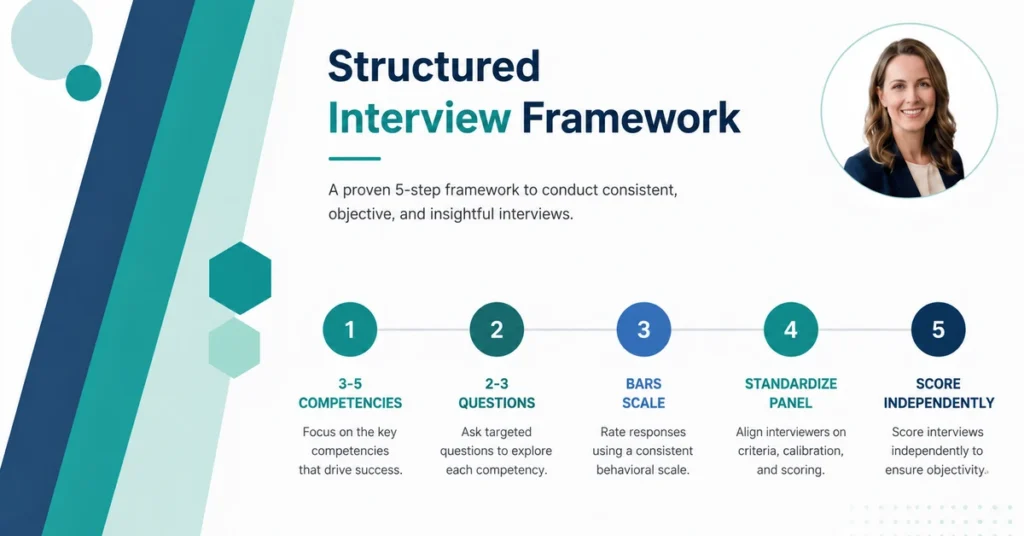
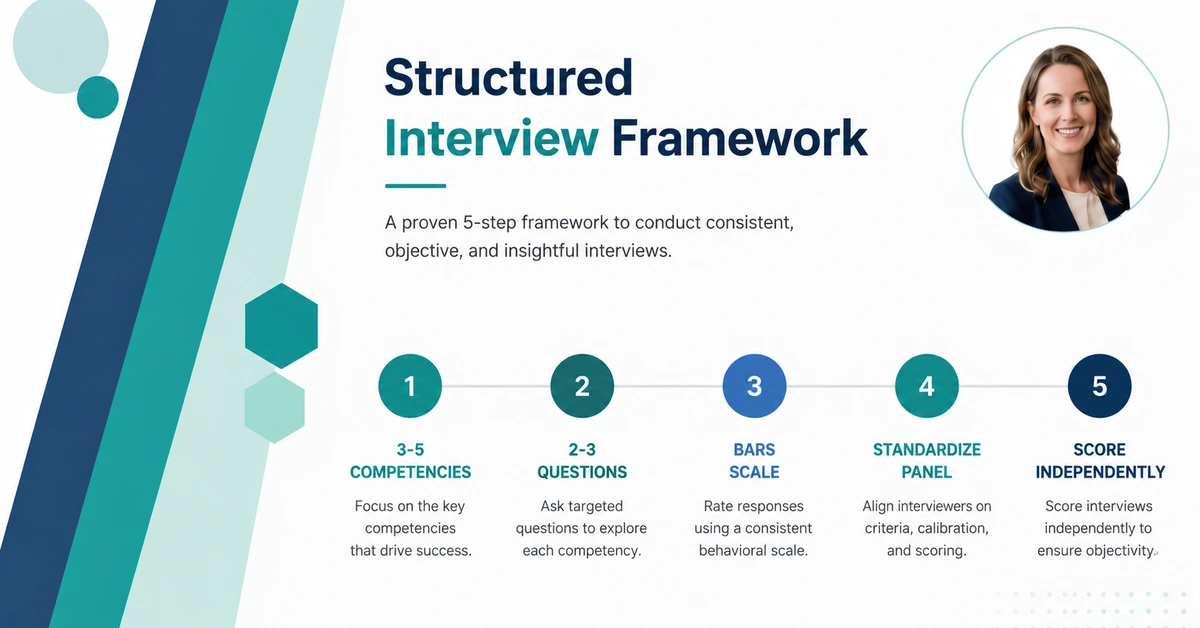
This is the part of skills-based hiring that turns the philosophy into a repeatable process, five steps, applied to any role, that a job description alone can’t deliver on its own.
Step 1: Pick 3 to 5 Competencies, Not 15
Every requisition tempts you to test for everything the role touches. Resist it. Research on structured interview design converges on covering three to five competencies per interview, with two to three questions per competency, for a total of eight to fifteen questions in a sixty-to-ninety-minute session. Pull the list from three sources: the hiring manager, whoever is currently succeeding in the role, and the skills-based job description you wrote for this posting, not the generic template from three years ago. If the list runs past five items, ask which three would still get someone hired even without the other two. Those are the ones worth an interview slot.
Step 2: Write Two to Three Questions Per Competency
Skills-based hiring runs on two question types that do most of the work: past-behavioral (“tell me about a time you…”) and situational (“if you were faced with…”). Both force a candidate to produce evidence instead of an opinion about themselves. A weak question invites a performance: “Are you good at prioritizing?” gets you a confident yes and nothing you can check. A strong question forces specifics: “Walk me through a week where two deadlines collided. What did you do first, and why?” Write the follow-up probes at the same time as the main question, not on the fly during the interview, so every interviewer is digging for the same evidence.
Step 3: Build a Behaviorally Anchored Rating Scale for Each Question
This is the step most teams skip, and it’s the one that actually creates the structure. A behaviorally anchored rating scale, BARS for short, describes what a 1, 2, 3, or 4 response actually sounds like in specific behaviors, not adjectives like “good” or “strong.” The technique comes from the critical incident method: pull real examples of weak, average, and strong answers from past interviews, or from top performers describing how they actually handled the situation, and use those as the anchor text for each score. Research on BARS in structured interviews has found it improves reliability, meaning two interviewers score the same answer the same way, and reduces bias against candidates from underrepresented groups compared to a generic 1-to-5 scale with no behavioral description attached.
Step 4: Standardize the Panel Before the Interview, Not During It
If more than one person is interviewing, decide in advance who owns which competency, what order the panel asks questions in, and how notes get taken. Panels that improvise their roles mid-interview tend to talk over each other, chase the same competency twice, and let whoever has the strongest personality dominate the scoring conversation afterward. A thirty-minute calibration session before the first interview, walking through what a 2 versus a 4 answer sounds like and practicing on a mock transcript, fixes most of this before it costs you a candidate.
Step 5: Score Independently, Before Anyone Talks
Every interviewer fills out their scorecard alone, immediately after the interview, before the group debrief starts. This single rule does more to control bias than almost anything else in the framework, because it removes the chance for one confident opinion to anchor everyone else’s score before they’ve formed their own. Compare scores in the debrief, and when two interviewers land far apart on the same answer, treat that as a sign the rubric language is ambiguous and needs to be rewritten, not as a tiebreak problem.
A Skills-Based Hiring Interview Example: Question, Scorecard, and Anchors
Competency: Prioritizing Under Competing Deadlines
Competency: Prioritizing Under Competing Deadlines
Question: “Tell me about a time two urgent priorities landed on you at once. How did you decide what came first, and how did it turn out?”
Probes: “What information did you have when you made that call?” and “How did you communicate the tradeoff to the person who didn’t get their thing first?”
| Score | What the Answer Sounds Like |
| 1 — Below bar | Can’t recall a specific instance, or describes reacting to whoever pushed hardest, with no stated reasoning. |
| 2 — Approaching bar | Describes a real instance, but the decision was reactive rather than based on stated criteria like impact or urgency. |
| 3 — Meets bar | Names the criteria used to rank the work, and describes communicating the tradeoff to the deprioritized stakeholder. |
| 4 — Exceeds bar | All of the above, and the candidate flagged the conflict before it became urgent, or built a repeatable method they still use. |
That’s the whole unit: one question, two probes, four anchor points, reusable for every candidate in the req. Multiply it by four or five competencies and the interview is built.
Where Skills-Based Hiring Interviews Break Down
Skills-based hiring only holds up if the interview stage holds up, and structure doesn’t eliminate bias by itself. It creates the conditions to catch it. The most common failure mode has a name in interview-ops circles: interviewer drift, where every interviewer ends up asking their own version of “tell me about a hard project,” and the debrief turns into comparing five different answers to five different questions. The fix is the same one from Step 2: write the questions down and use them exactly as written.
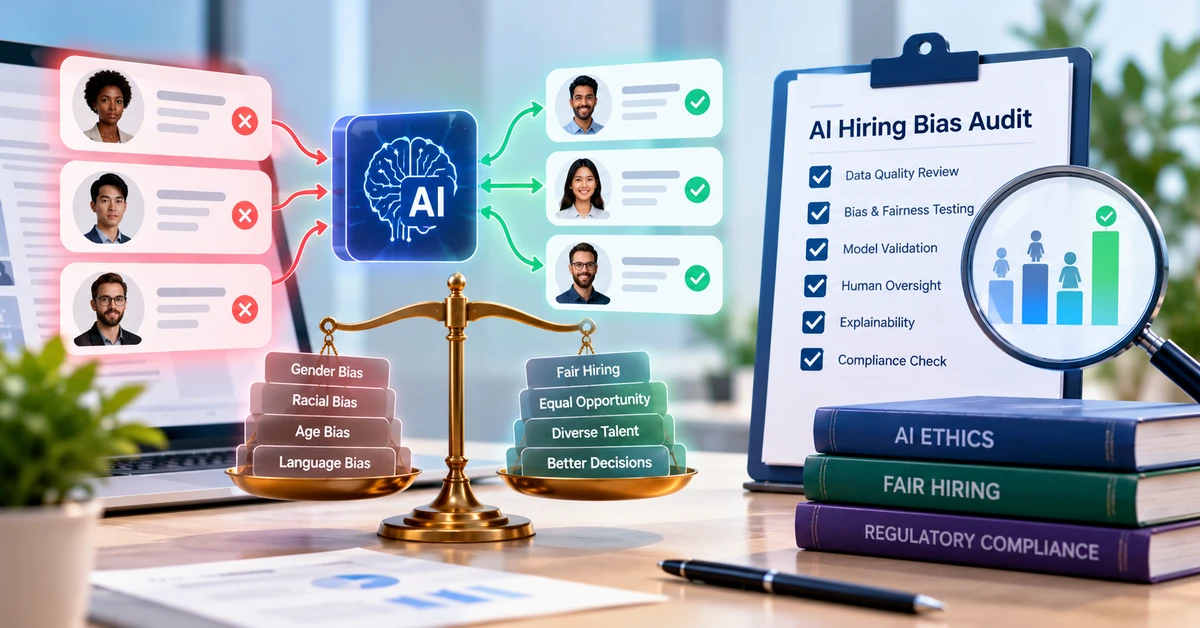
The next most common failures are the halo effect, where one strong answer early in the interview colors how the interviewer hears everything after it, and its mirror, the horn effect, where one weak answer does the same thing in reverse. Affinity bias shows up when an interviewer rates a candidate higher simply because they share a background, a school, or a communication style. All three are why Step 5, independent scoring before discussion, matters more than any other single rule in this framework: it forces the bias to show up on paper, where it can be caught, instead of staying invisible inside a group conversation that just feels like consensus.
None of this is solved once. Rubrics drift over a few hiring cycles the same way unstructured interviews do, usually because someone updates a question without updating the anchors, or a new interviewer never sat through calibration. A quarterly look at where interviewers disagree most shows which rubric language needs to be rewritten.
Where Skills-Based Hiring Tooling Fits
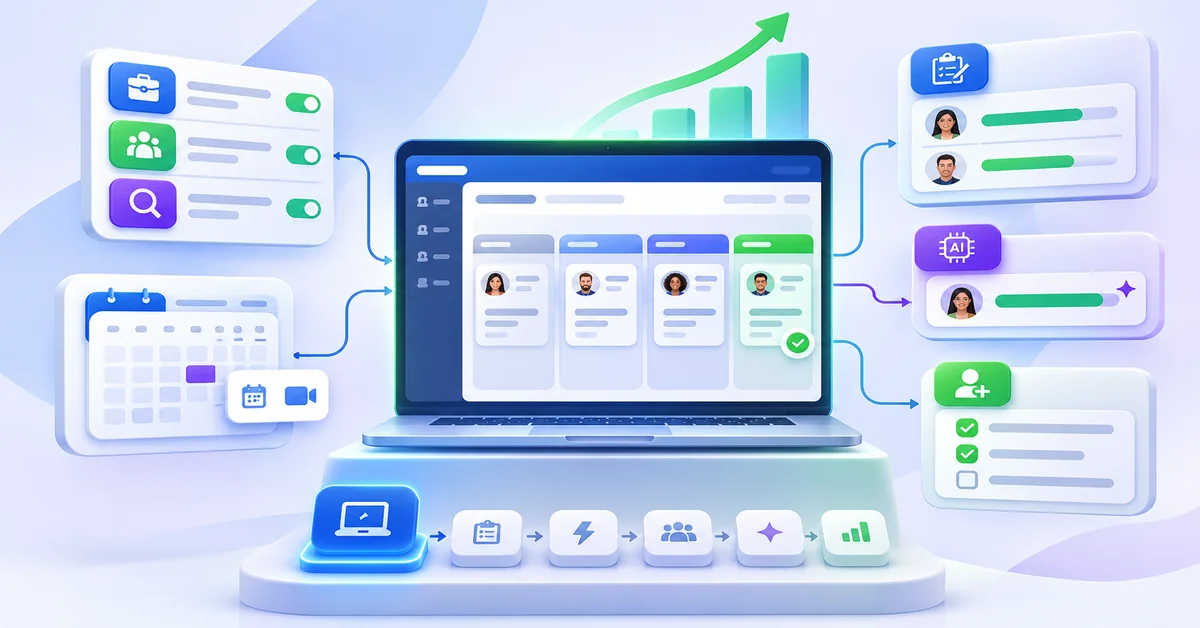
Everything above works for a skills-based hiring program with a shared doc and a spreadsheet. What breaks it in practice isn’t the framework, it’s maintenance: someone builds a good rubric for the initial rollout, then six months and four new hiring managers later, interviewers are back to free-form conversations because nobody kept the question bank current or trained the new panel members. This is the part worth handling inside the ATS rather than a doc nobody reopens. SmoothHiring’s interview kits keep the competency, question, and BARS anchors attached to the requisition itself, and its scoring models mean every interviewer fills out the same rubric inside the same screen instead of a version they half-remember from a training session two quarters back. The framework doesn’t change. What changes is whether it’s still being followed by interview forty of the quarter, not just interview one.
FAQ
What are the advantages of skills-based hiring?
What are the advantages of skills-based hiring?
The main advantages are a wider talent pool, up to 15.9x larger once degree filters are removed, stronger predictive accuracy than resume screening, and lower turnover, with some data showing a 91% retention lift when it’s paired with structured interviews. It also tends to improve diversity outcomes by removing credentials that weren’t predicting performance.
What are examples of skills-based hiring practices?
The core practices are skills-based job descriptions, listing required skills instead of degrees or years of experience, pre-employment skills assessments, structured interviews with a shared scoring rubric, and skills-based sourcing that widens the pipeline beyond degree-filtered candidates. Structured interviews are usually where programs break down, since consistency is harder to maintain than it looks.
What is a structured interview in skills-based hiring?
A structured interview asks every candidate for a role the same predetermined, job-related questions in the same order, then scores each answer against a shared rubric, usually a behaviorally anchored rating scale, before interviewers discuss the candidate as a group. It replaces free-form conversation with a repeatable, comparable process.
How many questions should a structured interview have?
Most structured interviews cover three to five competencies with two to three questions each, totaling eight to fifteen questions for a sixty-to-ninety-minute session. Fewer competencies covered well beats more competencies covered thinly, since each question needs a real behavioral anchor to score against.
What’s the difference between a structured interview and a behavioral interview?
Behavioral interviewing is a question style: asking candidates to describe past situations rather than hypotheticals. Structured interviewing is a process discipline, the same questions in the same order scored on the same rubric for every candidate. A structured interview usually uses behavioral questions, but the structure is what creates the validity.
Do structured interviews actually reduce hiring bias?
Yes, largely because independent scoring happens before group discussion, which stops one interviewer’s early opinion from anchoring everyone else’s. Behaviorally anchored rating scales add a second layer by replacing vague labels like “strong” with specific behavior descriptions, which research links to less bias against candidates from underrepresented groups.
Can structured interviews work for every role, or just technical ones?
They work for any role where you can name three to five job-relevant competencies in advance, which covers nearly every role. The competencies and questions change by function, sales versus engineering versus operations, but the process itself stays identical.