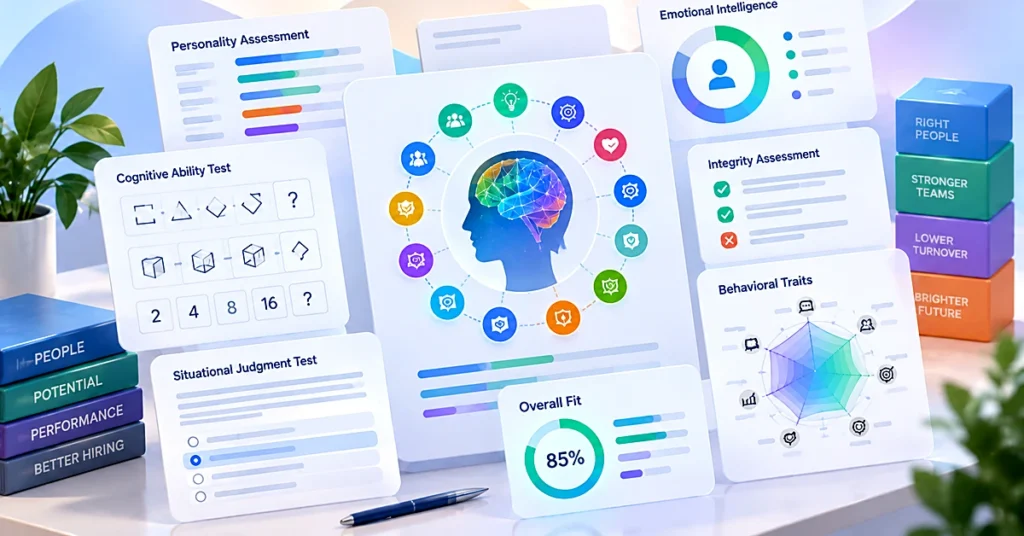



Psychometric testing isn’t one instrument. It’s a family of tools, each measuring a different aspect of how a person thinks, reasons, or is inclined to behave, and each with a different research record behind it. Choosing the wrong type for a role, a personality inventory for a job that actually needs a cognitive test, is one of the more common and avoidable mistakes in assessment design.
This guide walks through the main categories of psychometric tests used in hiring today, what each one actually measures, and which roles they fit best.
Key Takeaways
Psychometric testing is a family of tools, not one instrument. Personality inventories, cognitive ability tests, aptitude tests, situational judgment tests, integrity tests, and emotional intelligence tests each measure something different.
Work samples and cognitive ability tests are the strongest single predictors. Personnel selection research consistently ranks these above personality-only measures when used alone.
Most well-built programs combine two or three types. Rather than relying on one instrument to cover every aspect of fit.
Personality and Trait Inventories
These measure stable dispositions, most commonly organized around the Big Five: conscientiousness, emotional stability, extraversion, agreeableness, and openness. Barrick and Mount’s landmark 1991 meta-analysis found conscientiousness predicts job performance consistently across occupations, with emotional stability close behind. Trait inventories work best as a general-purpose signal of work style and team fit rather than a predictor of any single specific skill.
Type-Based Instruments
Tools like the Myers-Briggs Type Indicator sort people into categories rather than scoring them on continuous traits. They remain popular for team-building conversations, but their test-retest reliability, whether the same person gets the same result taking it twice, has drawn sustained criticism in the academic literature, and MBTI-style instruments are rarely recommended for hiring decisions specifically because of that reliability gap. A continuous trait model like the Big Five has a stronger research record for actual selection use.
Cognitive Ability Tests
These measure general reasoning, problem-solving, and how quickly someone learns new information. Cognitive ability tests generalize unusually well across roles, since most jobs require some reasoning under changing conditions, and they consistently rank among the strongest single predictors of job performance in personnel selection research.
Aptitude Tests
A narrower category than cognitive ability testing, aptitude tests target a specific reasoning skill: numerical reasoning, verbal reasoning, spatial or abstract reasoning. They’re useful when a role leans heavily on one particular kind of thinking, financial analysis roles and numerical reasoning, for example, rather than reasoning ability in general. A data analyst role might weigh numerical reasoning heavily while barely testing spatial reasoning at all; an industrial design role would likely do the reverse. The narrower focus is the point: an aptitude test trades breadth for precision on the specific skill that actually predicts success in a given role.
Situational Judgment Tests
Situational judgment tests present a realistic workplace scenario, a customer complaint, a conflict between coworkers, and ask the candidate to choose or rank their response. They measure applied judgment rather than abstract ability, and their scenario-based format makes them naturally harder to answer with a simple socially desirable response than a straightforward personality questionnaire.
Integrity and Honesty Tests
These assess the likelihood of counterproductive workplace behavior, theft, safety violations, policy breaches. Meta-analytic research by Ones and Viswesvaran found integrity tests carry a criterion-related validity of approximately 0.41 for predicting overall job performance, a solid figure in personnel selection research, and importantly found that social desirability bias does not meaningfully undermine that validity even though applicants do shade their answers somewhat.
Emotional Intelligence Tests
These measure self-awareness, empathy, and social skill, capacities that matter disproportionately in leadership and high-contact interpersonal roles. A leadership assessment might evaluate how well someone reads a tense room or adjusts their communication style for a frustrated direct report, distinct from the cognitive reasoning a general ability test would capture. Emotional intelligence testing is a younger field than personality or cognitive assessment, and the research base, while real, is less extensive than the decades of meta-analytic work behind the Big Five or general cognitive ability.
| Test Type | Measures | Best Used For |
| Personality/Trait Inventories | Stable dispositions such as conscientiousness and emotional stability | Predicting general work behavior and team fit |
| Cognitive Ability Tests | Reasoning, problem-solving, learning speed | Roles requiring judgment under changing conditions |
| Aptitude Tests | Specific reasoning skills: numerical, verbal, abstract | Screening for a defined mental skill the role needs |
| Situational Judgment Tests | Decision-making in realistic work scenarios | Customer-facing and people-management roles |
| Integrity/Honesty Tests | Likelihood of counterproductive workplace behavior | Roles with financial or safety trust requirements |
| Emotional Intelligence Tests | Self-awareness, empathy, social skill | Leadership and high-contact interpersonal roles |
How These Types Combine in a Real Hiring Process
Few well-designed programs rely on a single test type, because each type covers a different piece of the picture and leaves clear gaps on its own. A common, research-supported pairing looks like this: a cognitive ability test screens for general reasoning capacity early in the process, since it generalizes across almost any role and correlates with how quickly someone will ramp up. A situational judgment test or structured behavioral interview then adds a layer of applied judgment specific to the role, catching how a candidate actually handles the kind of scenarios the job produces day to day. For roles carrying financial, safety, or trust exposure, an integrity measure adds a third, distinct layer that neither cognitive nor situational testing covers on its own.
The mistake to avoid isn’t picking the wrong single test. It’s assuming one test type can stand in for all of them. A cognitive test says nothing about how someone handles a furious customer. A situational judgment test says nothing about how quickly someone will learn a new system. Matching combinations to what a specific role actually demands, rather than defaulting to whichever test is easiest to administer, is what separates an assessment program with real predictive power from one that’s just checking a box.
How to Choose the Right Type for a Role
Choosing among these types isn’t about finding the single best one. It’s about matching the test to what actually predicts success in a specific role, and being honest about what each type can’t tell you.
Start with what the role actually demands, not what sounds impressive. A warehouse role rarely needs an emotional intelligence test; a leadership role rarely needs a narrow numerical aptitude test.
Combine two or three types rather than relying on one. Cognitive ability plus a situational judgment test, for instance, covers both raw reasoning and applied judgment.
Weight toward job simulations and work samples where possible. Personnel selection research consistently finds work samples the single strongest predictor of any assessment type, psychometric or otherwise.
Revisit the choice once real outcome data exists. A test that seemed like the right fit on paper sometimes turns out to correlate weakly with actual performance in a specific role. Tracking outcomes against assessment scores over a few hiring cycles is the only way to confirm the combination is actually working, not just plausible.
Frequently Asked Questions
What is the most accurate type of psychometric test?
What is the most accurate type of psychometric test?
No single type is universally most accurate; accuracy depends on matching the test to the role. Cognitive ability tests and work sample simulations tend to show the strongest predictive validity across personnel selection research generally.
How many psychometric tests should a hiring process include?
Most well-designed programs use two or three, chosen to cover different aspects of fit, such as a cognitive test paired with a situational judgment test, rather than a long battery covering every possible trait.
Are integrity tests worth using for every role?
Not necessarily. Integrity testing shows the clearest value in roles with financial, safety, or trust exposure, cash handling, driving, healthcare access, where the cost of counterproductive behavior is highest. For roles without that exposure, the added signal is often smaller than what a cognitive or situational judgment test provides.
What’s the difference between a psychometric test and a skills test?
A skills test measures a specific, learned, job-relevant ability, like proficiency with a particular software tool. Psychometric tests measure more general psychological characteristics, reasoning ability, personality traits, judgment, that transfer across different specific tasks rather than testing one skill directly.
Conclusion
The right psychometric test is the one matched to what the role actually requires, not the most comprehensive one available. Understanding what each type measures, and what it doesn’t, is what turns psychometric testing from a checkbox into a genuine predictor of who will succeed.