



Yes, to a degree, and the research on this is more interesting than a simple yes or no. Job applicants do shade their answers toward what sounds desirable. But decades of research on exactly this question have found something that surprises most people who ask it: that shading doesn’t meaningfully break the test’s ability to predict who will actually perform well.
This piece covers what the research actually shows about faking on psychometric tests, why the effect is smaller than it seems, and what assessment design does to reduce it further.
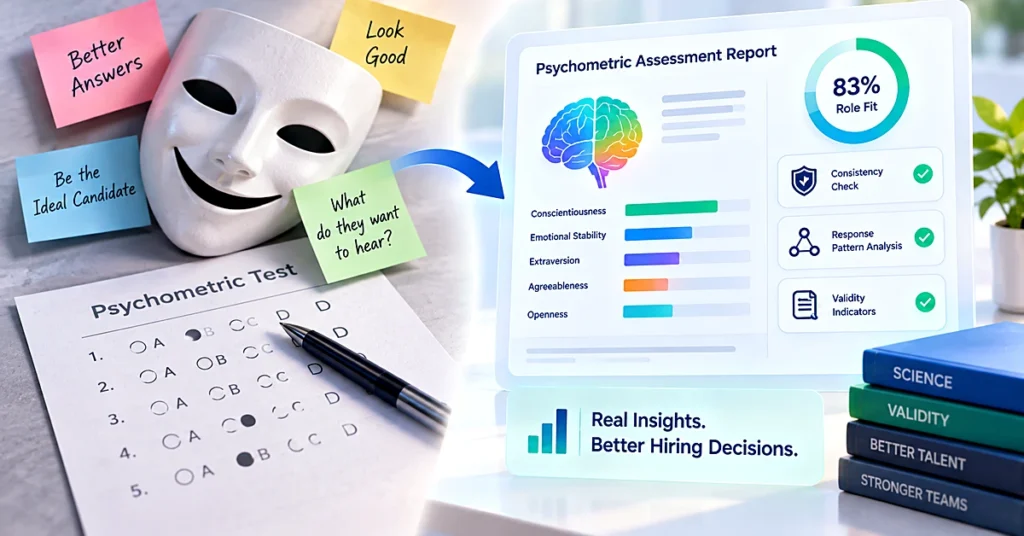
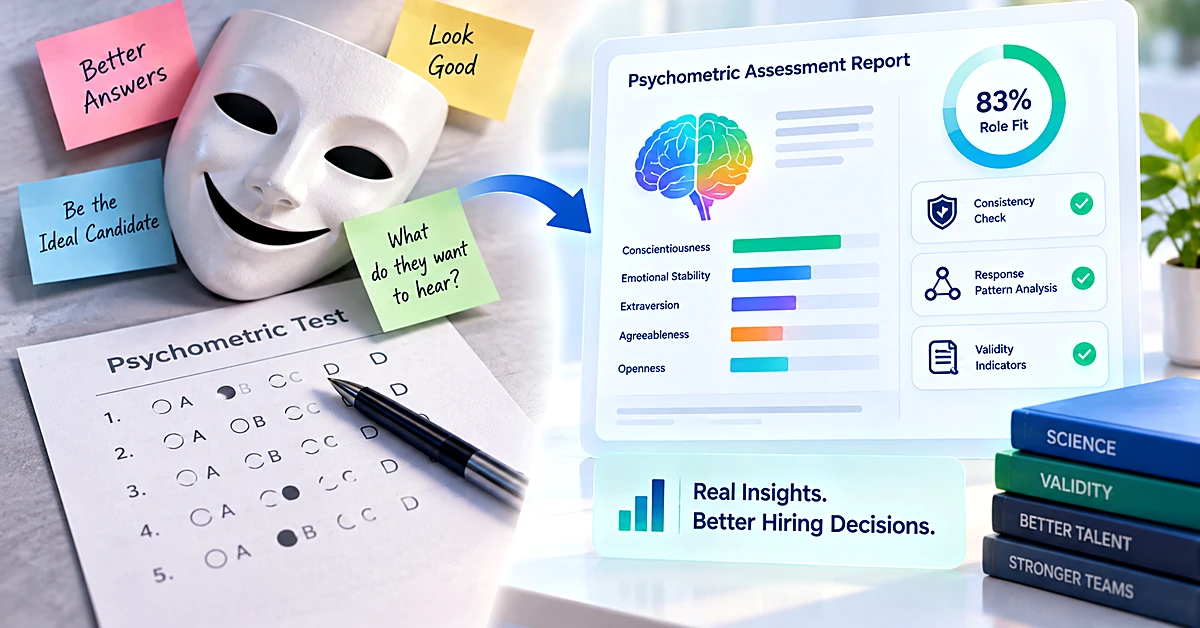
Applicants under-report undesirable traits and over-report desirable ones on personality and integrity tests, a well-documented pattern. But meta-analytic research by Ones and Viswesvaran found that controlling for social desirability leaves the predictive validity of personality and integrity measures intact, meaning the faking that does happen isn’t distorting what the test is actually measuring for selection purposes.
Key Takeaways
Yes, applicants shade their answers. Job applicants score somewhat higher on socially desirable traits than the same people answering outside a hiring context, a consistent, well-replicated finding.
But it doesn’t break the test. Controlling for social desirability statistically leaves the underlying predictive validity of personality and integrity measures essentially unchanged.
Format matters more than most employers realize. Situational judgment tests and forced-choice formats are structurally harder to fake than a straightforward personality questionnaire.
Real applicant data backs this up, not just lab studies. Research on actual retail sales applicants found the underlying structure of what was measured held up even when applicants were shading their answers in a genuine hiring context.
What the Research Actually Found
Ones and Viswesvaran’s review of personality and integrity testing in personnel selection found that job applicants do score somewhat higher on socially desirable traits, conscientiousness and emotional stability among them, than non-applicants answering the same questions outside a hiring context. That much is well established.
The more important finding is what happens next. When researchers statistically controlled for social desirability scores, the criterion-related validity of the underlying personality and integrity measures didn’t change. Integrity tests specifically showed a validity of roughly 0.41 for predicting overall job performance, and that figure held whether or not social desirability was accounted for. The faking exists, but it isn’t acting as the kind of distortion that would make the test meaningless.
A separate line of research helps explain why. A study of 1,084 retail sales employees compared their original job application data against two distinct forms of socially desirable responding: impression management, captured through a standard personality scale, and overclaiming, measured by asking applicants how familiar they were with a list of job-relevant products, some real and some invented, so overclaiming familiarity with a fictitious product served as a direct marker of exaggeration. Applicants in this study did shade their answers in predictable ways: they reported valuing security, tradition, and benevolence more than non-applicants did, and valued stimulation and personal achievement less, the kind of self-presentation shift you’d expect from someone trying to look like a safe, reliable hire. But the underlying structure of what the assessment measured held up even with that shading present, and the researchers were working with real applicants’ actual future sales performance, not a lab simulation where participants were told upfront to fake good.
How Assessment Design Reduces Faking Further
Beyond the research on whether faking matters, modern assessment design includes specific techniques that reduce how much room a candidate has to fake in the first place, on top of the fact that faking doesn’t appear to break validity even when it happens.
Forced-choice formats. Instead of rating each statement independently, where a candidate can simply mark every desirable trait as strongly true of themselves, a forced-choice format asks candidates to rank several statements against each other. Endorsing everything positively stops being an option, since the format requires trade-offs.
Situational framing over self-description. A question asking “How would you rate your stress tolerance?” invites a flattering self-assessment. A question asking “A customer is shouting at you over a mistake that wasn’t yours. What do you do first?” requires a specific, checkable answer that’s harder to fake convincingly without actually having the underlying judgment.
Response-pattern flags. Unusually fast completion times, implausibly uniform high scores across every trait, or response patterns statistically inconsistent with genuine variation can flag a profile for closer review, even without proving faking occurred.
Validated norms, not raw scores. Comparing a candidate’s score against a validated benchmark, rather than treating a raw number as meaningful on its own, makes it harder for a slightly inflated score to translate into an inflated hiring decision.
Why Faking Doesn’t Break the Test
Faking shifts the average, not the ranking. If most applicants shade their answers by a similar amount, the relative order between stronger and weaker candidates is often preserved even though every score moved up somewhat.
Some formats are harder to fake than others. Situational judgment tests, which ask candidates to respond to a specific scenario rather than rate themselves in the abstract, leave less room for a simple socially desirable answer than a straightforward personality questionnaire.
Extreme faking is often detectable. Modern assessment platforms can flag response patterns, unusually fast completion times, implausibly uniform high scores, that suggest an applicant answered strategically rather than honestly.
What This Means in Practice
The practical implication isn’t that faking doesn’t exist. It’s that a well-validated personality or integrity test remains a useful predictor even in a real applicant pool where some shading is guaranteed to happen. The research consensus doesn’t support throwing out personality and integrity testing over faking concerns. It supports choosing assessments with real validity evidence behind them, since that evidence already accounts for the reality of how applicants actually respond, not an idealized honest respondent who doesn’t exist in a hiring context.
Why the Concern Persists Anyway
If the research is this consistent, it’s worth asking why “candidates just fake these tests” remains one of the most common objections HR teams raise about psychometric assessment. Part of the answer is intuitive plausibility: it’s easy to imagine yourself answering a personality questionnaire strategically, so it feels obvious that everyone else would too. What that intuition misses is the aggregate effect. Even if every applicant shades their answers somewhat, the relative differences between candidates, who’s more conscientious than whom, tend to survive that shift, because most people are shading in the same direction by a similar amount rather than a few candidates gaming the system while everyone else answers with perfect honesty.
The other part of the answer is that the objection is usually raised about personality and integrity tests specifically, then applied as a blanket criticism of psychometric testing generally. Cognitive ability tests and work sample simulations, which make up a large share of what “psychometric assessment” actually covers in a modern hiring process, aren’t vulnerable to the same kind of self-report shading in the first place, since there’s no socially desirable way to fake a correct answer on a reasoning problem or a stronger result on a work sample.
Frequently Asked Questions
Do most job applicants fake personality tests?
Do most job applicants fake personality tests?
Most applicants shade their answers somewhat toward socially desirable responses, a well-documented pattern in personnel selection research, but full-scale strategic faking that changes hiring outcomes is less common than the concern suggests.
Which test types are hardest to fake?
Situational judgment tests and work sample simulations are generally harder to fake than straightforward personality questionnaires, since they require a candidate to respond to a specific scenario or perform an actual task rather than rate themselves in the abstract.
Can assessment platforms detect faking?
Some platforms flag response patterns associated with strategic answering, such as unusually fast completion or implausibly uniform high scores, though no method detects faking with certainty.
What is a forced-choice assessment format?
A forced-choice format asks candidates to rank or choose between several statements rather than rate each one independently, which prevents a candidate from simply marking every desirable trait as strongly true of themselves. It’s one of the more effective design techniques for reducing how much room faking has to operate in.
Are cognitive ability tests as fakeable as personality tests?
No. Cognitive ability tests and work sample simulations measure demonstrated performance on a task, which doesn’t have a socially desirable shortcut the way a self-report personality question does. Faking concerns apply almost entirely to self-report instruments like personality and integrity inventories.
Conclusion
Candidates do shade their answers on psychometric tests, and pretending otherwise would be naive. But the research on exactly this question has consistently found that faking doesn’t undo what a validated assessment is measuring. The more useful question isn’t whether candidates might exaggerate, they will, a little. It’s whether the assessment has real validity evidence behind it in the first place.