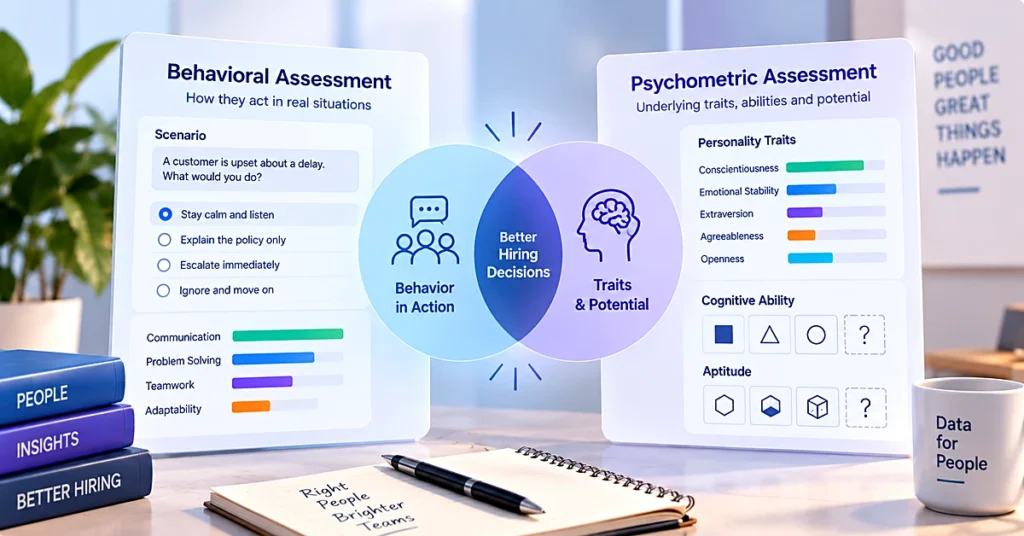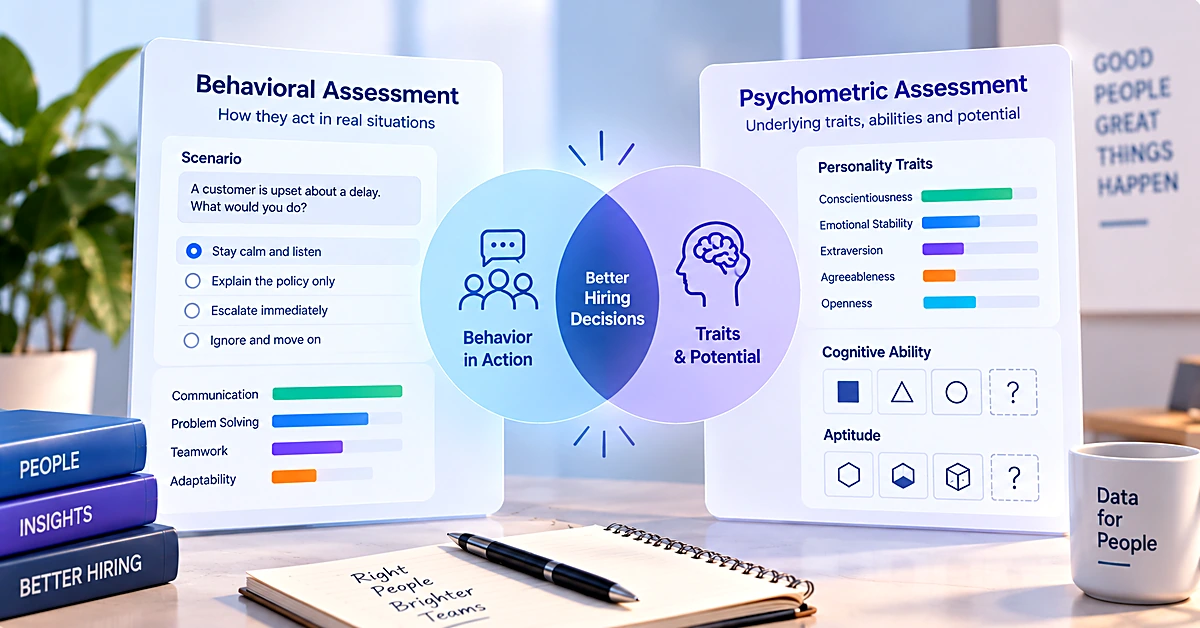





Behavioral assessment is a specific category within the broader field of psychometric assessment, not a competing alternative to it. Psychometric assessment is the umbrella term for any standardized measurement of psychological characteristics, personality, cognitive ability, aptitude, and behavior all fall under it. Behavioral assessment specifically measures how a candidate responds to real or simulated work situations, rather than the underlying trait that might explain that response. Getting this relationship right matters beyond terminology, since choosing the correct type for a role, or a defensible combination of types, starts with actually understanding what each category is built to measure.
The terms get used inconsistently across the industry, which is exactly why the confusion is common. This guide draws the distinction clearly and shows how the two work together in practice.
Key Takeaways
Behavioral assessment is a subset, not an alternative. It’s one specific category within the broader field of psychometric assessment, not a competing term for the same thing.
The core difference is what’s being measured. Behavioral assessment measures how someone responds to a specific situation; psychometric assessment more broadly measures underlying traits, abilities, and dispositions.
Each has a blind spot the other covers. Personality inventories miss situational nuance; behavioral assessments miss broad dispositional traits that show up across every situation.
A situational judgment test is technically both at once. It’s a standardized, scored psychometric instrument in the broad sense, and behavioral in what it specifically measures.
What Psychometric Assessment Actually Covers
Psychometric assessment is the broad category. It includes personality inventories, cognitive ability tests, aptitude tests, and behavioral assessments, anything that applies a standardized, scored method to measuring a psychological characteristic. When someone says a hiring process uses “psychometric testing,” they could be referring to any combination of these, which is part of why the term alone doesn’t tell you much about what’s actually being measured.
The word “psychometric” itself just means the measurement of psychological characteristics, mental abilities, personality traits, aptitudes, behavior, through standardized, scientifically validated methods rather than informal observation. That’s a genuinely broad definition, and it’s why a vendor description that only says “we use psychometric assessment” leaves a real question unanswered: measuring what, specifically, and how?
What Behavioral Assessment Specifically Measures
Behavioral Assessment narrows the focus to how a candidate is likely to act, communicate, or make decisions in job-relevant situations. It’s usually delivered through situational judgment tests, which present a realistic scenario and ask the candidate to choose or rank their response, or through structured behavioral interview questions built around specific competencies. Where a personality inventory asks a candidate to rate general statements about themselves, a behavioral assessment asks what they would actually do.
Consider two ways of getting at the same underlying question, whether a candidate handles conflict well. A personality inventory might ask a candidate to rate how much they agree with a statement like “I stay calm during disagreements.” A behavioral assessment instead presents an actual scenario, a coworker publicly criticizes the candidate’s work in a meeting, and asks what they would do next. The second format gives less room for a generic, flattering self-report and more insight into actual judgment under a specific kind of pressure.
| Behavioral Assessment | Psychometric Assessment | |
| What it measures | How a candidate responds to specific work situations | Underlying traits, abilities, and dispositions |
| Typical format | Situational judgment tests, structured behavioral interviews | Standardized questionnaires and cognitive/aptitude tests |
| Scope | A specific category within psychometric assessment | The broader category, including personality, cognitive ability, and aptitude |
| Best answers | What would you actually do in this situation | How you’re generally inclined to think or behave |
| Example | A scenario about handling an angry customer | A trait inventory measuring conscientiousness |
Why the Distinction Matters in Practice
Personality inventories predict general tendencies well but say less about how someone handles a specific type of situation. Behavioral assessments do the opposite: they’re strong on situational judgment but don’t capture the broader dispositional traits, like conscientiousness, that show up across every situation a person encounters at work. Used together, they cover more ground than either does alone, which is why most well-built assessment programs use a behavioral component alongside a broader personality or cognitive measure, not one instead of the other.
A Worked Example: Hiring for a Support Role
Picture a customer support role, and consider what each type of assessment would actually tell you about a candidate for it.
A psychometric personality inventory might reveal that a candidate scores high on conscientiousness and emotional stability, traits generally associated with reliability and staying composed under stress, across essentially any role.
A behavioral assessment built around this specific role might present a scenario: a customer is furious about a billing error and threatening to cancel. The candidate’s response to that scenario shows something the personality score can’t: how they actually apply composure to a specific, high-stakes interaction, not just whether they’re generally inclined toward calmness.
Neither result alone tells the full story. A candidate could score well on emotional stability in the abstract and still handle that particular kind of confrontation poorly, or score more modestly on the personality measure and still turn out to have real skill at de-escalation in the moment. Reviewing both together gives a hiring manager a fuller picture than either would on its own.
A Common Misconception Worth Clearing Up
One mix-up shows up often enough to address directly: assuming that because behavioral assessment sounds more concrete, testing an actual response to a scenario rather than an abstract trait, it must be the more rigorous or more scientific of the two. That’s not quite right. Both categories, when built on validated instruments, rest on the same underlying research tradition in personnel psychology. A well-constructed personality inventory has decades of meta-analytic validity evidence behind it, the same kind of evidence a well-constructed situational judgment test has. The difference between them is what they measure, general disposition versus situational response, not which one counts as more scientifically grounded.
The reverse mistake happens too: treating psychometric assessment as if it only means personality testing, and behavioral assessment as the more modern, more relevant alternative. Cognitive ability tests and aptitude tests are psychometric instruments as well, and among the categories with the strongest predictive validity in the research literature. Neither term maps cleanly onto “old-fashioned” or “cutting-edge.” They’re just describing different things being measured.
Frequently Asked Questions
Is behavioral assessment a type of psychometric test?
Is behavioral assessment a type of psychometric test?
Yes. Behavioral assessment is a specific category within the broader field of psychometric assessment, alongside personality inventories, cognitive ability tests, and aptitude tests.
Which is more accurate, behavioral or psychometric assessment?
Neither is universally more accurate; they measure different things. Behavioral assessments predict situational responses well, while broader psychometric measures like personality and cognitive ability tests predict general work tendencies. Combining both typically outperforms relying on either alone.
Can a single assessment be both behavioral and psychometric?
Yes. A situational judgment test is both: it’s a psychometric instrument in the broad sense, standardized and scored, and behavioral in what it specifically measures, a candidate’s likely response to a real work scenario.
Should a hiring process use behavioral or psychometric assessment?
Most well-built processes use both rather than choosing one. A broader psychometric measure, like a personality or cognitive ability test, screens for general fit and reasoning capacity, while a behavioral component adds a role-specific layer of applied judgment that a general measure can’t capture on its own.
Is a structured behavioral interview the same as a behavioral assessment?
They’re closely related. A structured behavioral interview asks candidates to describe how they’ve handled specific past situations, following a set of predetermined, scored questions. A behavioral assessment often does something similar through a written or simulated scenario rather than a live conversation, but both fall under the same behavioral category and are typically more reliable than an unstructured interview.
Does the terminology actually matter for choosing an assessment vendor?
It matters enough to ask a direct follow-up question when a vendor uses either term. “We use psychometric assessment” could mean almost anything, from a short personality survey to a full battery covering cognitive, behavioral, and integrity measures. Asking specifically what’s being measured, and through which format, gets a more useful answer than the category label alone.
Conclusion
Behavioral assessment isn’t a rival term to psychometric assessment; it’s one specific, valuable category inside it. Getting the terminology straight matters less for its own sake than for what it clarifies: a hiring process that only tests personality traits and one that only tests situational judgment are each missing something the other would catch, and knowing the difference is what makes it possible to build a program that uses both deliberately, rather than defaulting to whichever term a vendor happened to use first.