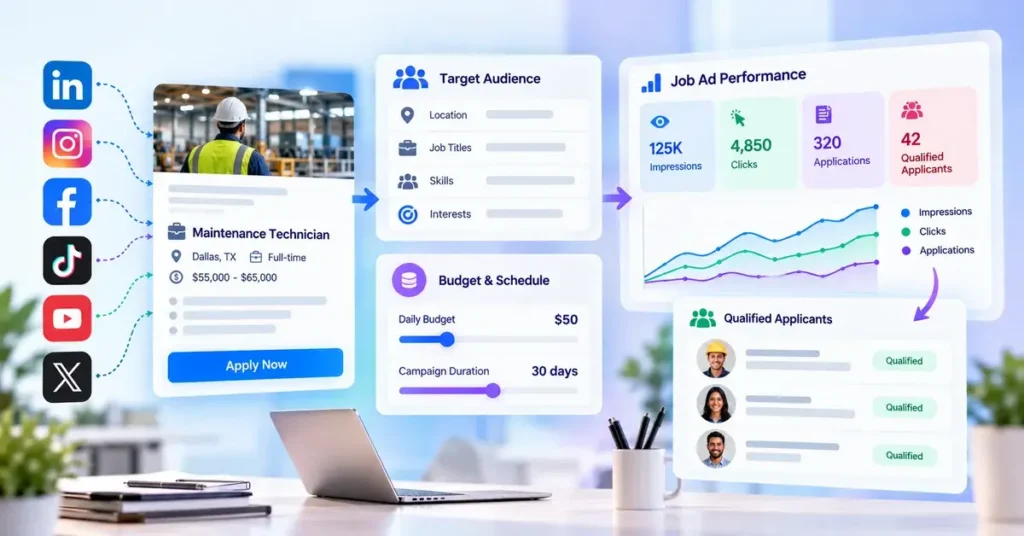




To advertise jobs on social media without wasting budget, treat it as a campaign with a defined audience, a tracked path to application and a cost measured per qualified applicant, not per click. Sharing a job on your company page is organic reach and costs nothing but time. Paid social media job advertising puts money behind a message so people who do not follow you see it, and that is where budget disappears when targeting is loose or the numbers being watched are the wrong ones.
Key takeaways
Organic posting and paid advertising solve different problems. Organic reaches people who already follow you. Paid reaches people who do not.
The usual waste comes from chasing cheap clicks or cheap applications. Cost per qualified applicant is the number that tracks hiring outcomes.
No platform is best for every role. Choose channels by where your target candidate spends time and how well you can target them there.
Fix the job ad and the application path before adding budget. Spend amplifies whatever is already there, flaws included.
Organic social sharing vs. a structured job advertising campaign
Social recruiting, also called social media recruiting, often starts with organic sharing: posting a job from your company page or personal profiles and letting your network see it. It costs no ad spend, though it does cost staff time, and its reach depends on who already follows you. A structured campaign, also called paid job advertising or social media recruitment advertising, has a defined audience, a budget, a tracked link to the application and a rule for when to change or stop it.
Organic sharing can be enough when the role is easy to fill, your audience already follows you and the timeline is flexible. A local business with an engaged page, or a team hiring through employee referrals, often fits. Paid promotion makes more sense when the role is hard to fill, the deadline is close, you are opening a new location, or the people you need neither follow your pages nor search job boards. The real choice is whether your existing reach is large enough for this particular role.
The path from job to hire
Every dollar of recruitment advertising moves along one chain: job → audience → channel → advertisement → budget → targeting → click → application → qualified applicant → hiring outcome. Waste enters when one link is vague, because every later link inherits the problem.
| Link | Decision to make | How waste creeps in |
|---|---|---|
| Job | Role, must-have requirements, pay, location | Unclear requirements bring unqualified applicants |
| Audience | Who the ideal candidate is and where they spend time | Describing “anyone who might apply” |
| Channel | Which platform or board reaches that audience | Choosing by habit |
| Advertisement | Headline, pay, requirements, call to action | Generic copy that appeals to everyone and no one |
| Budget | Total spend, daily pace, end date | Spending with no cap or end rule |
| Targeting | Location, skills, titles, interests | Broad targeting that buys unneeded impressions |
| Click | Landing page and tracking link | Clicks that cannot be traced to an application |
| Application | Short, mobile-friendly form | Long forms that lose motivated people |
| Qualified applicant | Screening criteria applied consistently | Treating every application as equal |
| Hiring outcome | Interviews, offers, hires, time to fill | Never connecting spend to hires |
Define the target candidate before you spend
Write a short candidate profile before opening an ad account: required skills or licenses, commute range, schedule, pay expectations and the one or two things that make the job appealing. Then note where those people spend time online. A licensed electrician and a seasonal retail associate are probably reachable through different channels.
HChoose channels without assuming one always wins
Platform fit depends on the role, the audience and how well you can target there. Treat the table as a starting hypothesis and let your own results settle it.
| Channel | Where it tends to fit | Watch for |
|---|---|---|
| Professional, skilled and specialized roles; targeting options include job titles, skills and seniority | Competition for the same candidates, so compare cost per qualified applicant | |
| Facebook and Instagram (Meta) | Local, frontline and high-volume roles where broad reach helps | Employment ads have restricted targeting, so creative and pay details carry more weight |
| Other channels (TikTok, X, Reddit, YouTube) | Specific communities or niche audiences, tested with small budgets | Rules and results vary by platform and by employment-ad policy; compare against your baseline |
Write a clear job advertisement, then test it
A clear ad names the job in plain words, states pay and schedule where you can, lists the two or three real requirements, and ends with one call to action that leads straight to a short application. Some US states and cities require pay ranges in job ads, so check local rules. Vague ads attract broad clicks. Specific ads filter people out before they click, which saves money.
Test one variable at a time: the headline, the pay line, the image or the call to action. Give each variant enough clicks to compare before declaring a winner, and judge it on qualified applicants, not just clicks.
Target relevantly and avoid overly broad audiences
Targeting should narrow the audience to people who could plausibly do the job: a realistic commute distance, relevant skills or job titles on LinkedIn, relevant interests on Meta. Broad targeting is cheap per impression and expensive per hire.
Employment ads also carry platform rules. On Meta, employment ads from US advertisers aimed at audiences in the US or Canada fall under the Special Ad Category. According to Jon Loomer’s guide, that fixes age and gender settings, removes ZIP-code targeting, limits some detailed targeting and disables lookalike audiences. Rules change, so check current policies before building audiences, and never target by protected characteristics.
Match budget to hiring urgency
Start from the outcome. Qualified applicants needed = hires needed × qualified applicants you usually need per hire. Budget = qualified applicants needed × cost per qualified applicant. Use your own history for both inputs. As an example, if six qualified applicants typically produce one hire and your cost per qualified applicant has been $50, plan about $300 for that hire from this channel. That is an illustration, not a benchmark. For wider ranges, see our guide on how much to spend on job advertising.
Urgency changes pacing, not the formula. An urgent role justifies a higher daily budget, more channels and a daily check, accepting a higher cost per qualified applicant to fill the seat sooner. A flexible role can run a lower daily budget over more weeks, with organic posts and free distribution doing part of the work.
Recruitment advertising metrics that matter
Track every stage so you can see where money leaks. Reach counts unique people, while impressions count every display, repeat views included (Sprout Social).
| Metric | Formula or meaning | What it tells you |
|---|---|---|
| Impressions | Times the ad was displayed | Exposure, including repeat views |
| Reach | Unique people who saw the ad | How many different people you reached |
| Clicks | Clicks on the ad’s link | Interest in the offer |
| CTR | Clicks ÷ impressions | Whether the ad and audience match |
| Applications | Completed applications | Volume of response |
| Cost per click (CPC) | Spend ÷ clicks | Price of attention |
| Conversion rate | Applications ÷ clicks | Whether the page and form turn interest into applications |
| Cost per application | Spend ÷ applications | Price of response, not of quality |
| Qualified applicants | Applications that pass your screening criteria | Fit |
| Cost per qualified applicant | Spend ÷ qualified applicants | Price of fit, the number to manage |
Why cost per application can mislead. A cheap application is not necessarily a good applicant. Broad targeting and a generic ad can lower the cost per application while filling the pipeline with people who lack the license, schedule or location the role needs. Your team then spends hours screening them, and the clicks that produced them were money wasted. Cost per qualified applicant corrects this by dividing spend by only the people who pass screening. Impressions fail the same way: a large number shows exposure, not hiring progress.
An illustrative budget example
These numbers are invented to show the math. They are an example, not an industry benchmark. Imagine a regional home-services company hiring an HVAC technician and running two $500 campaigns for the same job.
| Metric | Campaign A: broad targeting, generic ad | Campaign B: narrow targeting, specific ad |
|---|---|---|
| Spend | $500.00 | $500.00 |
| Impressions | 100,000 | 50,000 |
| Clicks | 1,000 | 400 |
| CTR | 1.0% | 0.8% |
| Cost per click | $0.50 | $1.25 |
| Applications | 50 | 25 |
| Conversion rate | 5.0% | 6.3% |
| Cost per application | $10.00 | $20.00 |
| Qualified applicants | 4 | 10 |
| Qualified rate | 8.0% | 40.0% |
| Cost per qualified applicant | $125.00 | $50.00 |
Campaign A wins on cost per click ($0.50 against $1.25) and on cost per application ($10.00 against $20.00). Campaign B wins where it counts. It produced 10 qualified applicants against 4, and its cost per qualified applicant is $50.00 against $125.00, which is 60% lower. A team watching only cost per application would have scaled the wrong campaign.
Optimize underperforming campaigns
Set rules before launch so decisions do not depend on mood. Read the funnel from the top and fix the first weak stage:
Low CTR: the ad or the audience is off. Change the headline or narrow the targeting.
Healthy clicks but few applications: fix the landing page or shorten the form.
Healthy applications but few qualified ones: state requirements more clearly in the ad or tighten targeting.
Cost per qualified applicant above your ceiling after a fair test: pause the campaign and move budget to a channel that is working.
Organic vs. paid social vs. job board sponsorship vs. multi-channel distribution
These four options are often lumped together, but each answers a different need.
| Option | Choose it when | Watch out for |
|---|---|---|
| Organic posting | The role is easy to fill, your audience already follows you and time is flexible | Reach is capped by your following, and results are hard to attribute |
| Paid social advertising | You need people who are not actively searching, or a specific audience, and you can track applications | Employment-ad targeting rules, creative fatigue and low-fit clicks |
| Job board sponsorship | Candidates already search job boards for this kind of role | Cost per click rises with competition, so compare cost per qualified applicant across boards |
| Multi-channel job distribution | You hire often, across many roles or locations, and want free reach on many boards first | Free postings still need a strong ad, and distribution alone does not buy visibility |
A practical order: start with multi-channel job distribution and organic posts, use sponsored job promotion where candidates already search (our look at which job boards deliver hires can help you choose), and add paid social when the data shows a gap or the role needs people who are not looking. Review everything by cost per qualified applicant, not by channel preference.
How a recruitment platform ties advertising, distribution and tracking together
Spend leaks fastest when advertising, distribution, applications and reporting sit in separate tools, because nobody can trace a click to a hire. A recruitment platform can combine four jobs: publish the ad, distribute it across channels, collect and screen applications in one place, and report cost and results by source. That also makes recruitment marketing easier to measure.
SmoothHiring is one example. Its job advertising software page describes posting jobs to a network of job boards, testing different headlines, descriptions and calls to action, and analyzing campaign data to improve reach and reduce cost per applicant. Its job distribution software page lists social channels among its distribution options. Whatever tool you choose, make sure it ties each application back to its source, since that is what lets you calculate cost per qualified applicant and decide where to advertise job openings next.
Frequently asked questions
How do you advertise a job on social media?
How do you advertise a job on social media?
Define the target candidate, choose a channel that reaches them, write a clear ad with pay and requirements, set a budget and targeting, and send clicks to a short, tracked application. Then review qualified applicants and cost, and adjust or pause weak ads.
Is it free to advertise jobs on social media?
Posting a job from your own pages costs no ad spend, though it takes staff time and mainly reaches people who already follow you. Paid ads, boosted posts and promoted job listings cost money, usually charged by click or impression.
Which social media platform is best for job advertising?
None is best for every role. LinkedIn often fits skilled or professional roles, and Meta platforms such as Facebook and Instagram can suit local or high-volume hiring. Test small budgets and compare cost per qualified applicant.
How much should I spend advertising a job?
Work backward from hires: multiply the qualified applicants you need by your cost per qualified applicant, using your own past data. Set a cap and an end date, and spend faster only when the role is urgent.
How do I target candidates on social media?
Target by realistic commute distance, relevant skills or job titles, and interests that match the role, and avoid overly broad audiences. Meta restricts targeting options for employment ads, and protected characteristics must never be used.
How can I reduce job advertising costs?
Improve the ad and the application form first, narrow targeting to likely candidates, test one variable at a time, pause weak campaigns, and manage to cost per qualified applicant instead of cost per click. Use free distribution for easy-to-fill roles.
What is the difference between organic and paid job advertising?
Organic job posts reach people who already follow or find you and carry no ad spend. Paid job advertising puts a budget behind a post to reach new audiences, with targeting and tracking, and costs money per click, impression or application.
How do I measure social media recruitment advertising ROI?
Compare spend with outcomes: cost per qualified applicant, interviews, offers, hires and time to fill by channel. Divide ad spend by hires for cost per hire, and use tracked links or source data to tie each application to its ad.
Conclusion
Advertising jobs on social media works when the campaign is built around a candidate, not a post. Define who you need, choose channels on evidence, write a specific ad, keep targeting tight, and judge every dollar by qualified applicants instead of clicks. Where the numbers say a channel is not working, move the money.