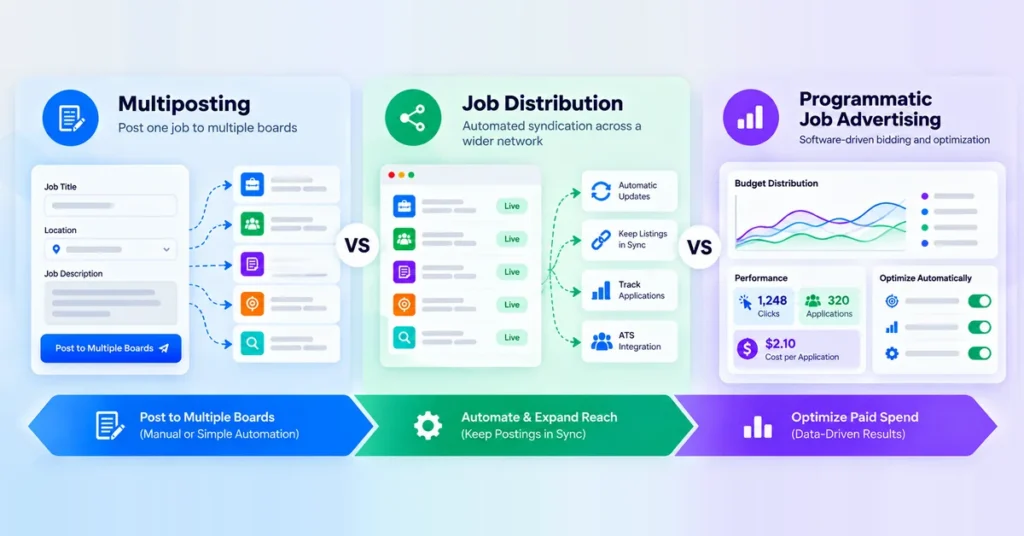




Multiposting, job distribution and programmatic job advertising get used as if they were three names for one thing. They are not. Multiposting means publishing one job to several job boards from a single screen. Job distribution automates that delivery across a wider network and keeps postings current. Programmatic job advertising adds software-driven budget allocation and bidding to paid job ads.
The difference matters because each solves a different problem and asks for a different amount of money and attention. A five-person firm that buys programmatic software for two openings a year will overpay. A logistics company filling hundreds of driver roles through manual multiposting will leave results on the table. This guide defines each term, compares them side by side, and explains which fits which hiring situation, without naming a universal winner.
Key takeaways
Multiposting is a posting method, job distribution is an automated delivery system, and programmatic advertising is an optimization layer for paid spend.
The three overlap. Most distribution platforms include multiposting, and some add sponsorship controls that edge toward programmatic buying.
No approach is better everywhere. Match the method to hiring volume, role difficulty, budget and how much reporting your team will actually use.
Free reach and paid reach are separate decisions. Distribute first, then pay for reach where the data shows a role is stalling.
How the three terms relate
Think of them as layers. Multiposting is the posting step: one job, many boards. Job distribution wraps that step in automation, usually connecting to an applicant tracking system (ATS) so postings publish, update and come down without manual work. Programmatic job advertising sits on top of paid placements, using software to decide where ad budget goes based on results such as cost per click or cost per application.
The terms overlap because one job can pass through all three. A recruiter writes the job in the ATS, a distribution tool pushes it to a board network, and a programmatic engine decides which paid placements deserve budget. Each layer is optional, and teams can buy them separately or together.
What is multiposting?
Definition. Multiposting, also called job multiposting or multi job posting, is publishing a single job to several job boards from one place instead of re-entering it on each site. The tool that does this is usually called multiposting software or a job multiposter, and it falls under the wider category of job posting software.
Purpose. It removes duplicate data entry. Without it, a recruiter retypes the same title, description and requirements into every board’s form and fixes the same typo in each.
How it works. The recruiter writes the posting once, picks the boards, and the software submits it to each one through an integration or account connection. Some boards accept the job free, while others sit behind paid plans and keep their own fees. Which boards to pick is a separate question, covered in our look at which job boards actually deliver hires.
Advantages and limits. Multiposting is simple, quick to adopt and easy to explain to a hiring manager. The limits appear over time. Edits and expirations may still need handling board by board, reporting is often thin, and the channel list is whatever the tool supports. It also says nothing about how much to spend or where.
Best use case. A team with a handful of openings at a time. An accounting firm posting a staff accountant role to four boards in one sitting is a typical fit.
What is job distribution?
Definition. Job distribution is the automated syndication of job postings across a network of job boards, aggregators and other channels, with postings kept in sync as the job changes. Job distribution software is the usual name for the tool, and you will also see it called job board distribution.
Purpose. The goal is reach with low effort: put each role in front of candidates wherever they search, and keep every listing accurate without manual follow-up.
How it works. A job is created or edited in an ATS or posting tool. The platform sends it to connected channels through feeds or integrations, refreshes it when details change, and removes it when the role is filled. Better platforms also tag each applicant with its source, so the team can see which channel produced the application.
Advantages and limits. Distribution scales better than manual multiposting, reduces stale listings and produces source-level data. It is still mostly a delivery system. Free placements compete with every other listing on a board, so a weak posting in a tight market can sit on page ten of the results.
Best use case. Ongoing hiring across many roles or locations. Picture a restaurant group opening a new site, with six location postings that must go live together, refresh weekly and disappear the moment each seat fills.
What is programmatic job advertising?
Definition. Programmatic job advertising, also called programmatic recruitment advertising, is the automated buying, placement and optimization of job ads using software instead of manual decisions. DirectEmployers Association describes it as an optimization layer above the job boards, not a replacement for them.
Purpose. It aims to produce more applications for each advertising dollar by moving budget toward the jobs and channels that perform.
How it works. Jobs flow in from an ATS, usually through a feed. The platform runs paid placements on a pay-for-performance basis, such as cost per click or cost per application, tracks results by channel and by job, and reallocates budget as those results change. People still set the goals, budgets and caps.
Advantages and limits. Spend moves away from channels that are not working without someone watching a dashboard. The costs are real, though. Programmatic needs enough hiring volume and budget for the algorithm to learn, and it can favor cheap clicks over good candidates unless quality signals are tracked. College Recruiter lists higher cost for smaller businesses and heavy reliance on algorithms among the drawbacks.
Best use case. High-volume or hard-to-fill hiring with a real paid budget. DirectEmployers Association ties it to high-volume, multi-location and hard-to-fill roles, and a logistics company filling drivers across several states, where some cities fill in days and others stall, fits that description.
Multiposting vs. job distribution vs. programmatic: side-by-side comparison
Attribute Multiposting Job distribution Programmatic job advertising Definition Publishing one job to several boards from one place Automated syndication of jobs across a network of boards and channels, kept in sync Software-driven buying and optimization of paid job ads Main purpose Save time on repeated data entry Maximize reach and keep postings current Get more applications per advertising dollar Automation Posting step; updates may stay manual Publishing, refreshing and removal, often tied to an ATS Placement, bidding and budget shifts Number of channels A defined list of boards Often a large network of boards and aggregators Many channels, weighted by performance Organic distribution Yes, mostly free postings Yes, the core function Not the focus; paid placements Paid advertising Optional, board by board Optional sponsorship on some platforms Core Budget optimization None Manual or basic rules Automated reallocation based on results Targeting By choice of boards By board, location and job category By job, location, audience and channel Performance optimization Manual review Source-level reporting; adjustments often manual Continuous, algorithm-driven Best use case A few roles on a few boards Ongoing hiring across many roles or locations High-volume or hard-to-fill roles with a paid budget Ideal user Small teams and occasional hirers SMB and mid-market recruiting teams High-volume employers and recruitment agencies
Where the three overlap
| Attribute | Multiposting | Job distribution | Programmatic job advertising |
|---|---|---|---|
| Definition | Publishing one job to several boards from one place | Automated syndication of jobs across a network of boards and channels, kept in sync | Software-driven buying and optimization of paid job ads |
| Main purpose | Save time on repeated data entry | Maximize reach and keep postings current | Get more applications per advertising dollar |
| Automation | Posting step; updates may stay manual | Publishing, refreshing and removal, often tied to an ATS | Placement, bidding and budget shifts |
| Number of channels | A defined list of boards | Often a large network of boards and aggregators | Many channels, weighted by performance |
| Organic distribution | Yes, mostly free postings | Yes, the core function | Not the focus; paid placements |
| Paid advertising | Optional, board by board | Optional sponsorship on some platforms | Core |
| Budget optimization | None | Manual or basic rules | Automated reallocation based on results |
| Targeting | By choice of boards | By board, location and job category | By job, location, audience and channel |
| Performance optimization | Manual review | Source-level reporting; adjustments often manual | Continuous, algorithm-driven |
| Best use case | A few roles on a few boards | Ongoing hiring across many roles or locations | High-volume or hard-to-fill roles with a paid budget |
| Ideal user | Small teams and occasional hirers | SMB and mid-market recruiting teams | High-volume employers and recruitment agencies |
Where the three overlap
Multiposting is the oldest and simplest form of distribution. Job distribution software includes it, then adds automation and syndication. Sponsorship blurs the line further. When a distribution platform lets you attach a budget to a job on a board such as Indeed or ZipRecruiter, it is doing paid advertising, though not necessarily programmatic advertising.
The test is who decides where the money goes. If you pick the board and set the budget by hand, you are running sponsored postings. If software reallocates spend across channels based on live results, that is programmatic. Job advertising, in turn, is the umbrella term for any paid promotion of a role, including sponsored listings, social ads and programmatic buying.
Which approach fits which hiring situation
No method wins everywhere. These are starting points, and the trade-off column matters as much as the fit. For budget ranges, see our guide to how much to spend on job advertising.
| Situation | Usually fits best | Trade-off to weigh |
|---|---|---|
| High-volume hiring | Job distribution, with programmatic once volume justifies it | Programmatic needs data to learn, and cheap applications are not always good ones |
| SMB hiring | Multiposting or distribution, plus capped sponsorship on stalled roles | Reporting is thinner at the simple end, and full programmatic is often more than a small team can use |
| Hard-to-fill roles | Distribution plus targeted paid advertising | More clicks do not fix a weak posting or an uncompetitive offer |
| Urgent hiring | Distribution for fast, wide reach, then a sponsored boost on boards that respond | A boost speeds up applicants but cannot rescue a slow interview process |
| Multiple locations | Job distribution with location-level postings; programmatic across many sites | Location data must be accurate, and budget spreads thin across sites |
| Niche roles | Multiposting to specialty boards, with paid placement on niche channels | Broad distribution wastes spend, and some specialty boards may need their own accounts |
| Limited recruitment budgets | Multiposting or distribution to free channels first | Free reach has a ceiling, so test paid spend on one role before scaling |
How modern platforms combine distribution, sponsorship and performance data
The lines between the three have softened because buyers want one workflow, not three vendors. A modern job distribution platform typically does three things at once. It publishes jobs to a board network automatically, lets recruiters attach budgets to selected jobs for sponsored placement, and reports applicants and cost by source so the next decision rests on data instead of habit. Some platforms adjust spend automatically as well. Full programmatic engines go further, with bidding and cross-channel reallocation at scale.
SmoothHiring is one example. Its automated job distribution page describes posting to a network of job boards, optional sponsored placements on boards such as LinkedIn and ZipRecruiter with budgets the user sets, and reporting on applicant volume and cost per applicant by source. Teams that want paid reach without managing separate campaigns can see how it fits together on the job advertising software page. As with any vendor, ask how much of the budget logic is automated bidding and how much is rules you set yourself. That tells you whether you are buying distribution with sponsorship or true programmatic buying.
Frequently asked questions
What is job multiposting?
What is job multiposting?
Job multiposting is publishing one job posting to several job boards from a single place, so recruiters do not re-enter the same details on each site. It saves time on posting, but it usually does not manage updates, budgets or performance across boards.
What is job distribution?
Job distribution is the automated syndication of job postings across a network of job boards and other channels, with listings kept current as roles change. It is usually connected to an ATS and reports which channel each applicant came from.
What is programmatic job advertising?
Programmatic job advertising uses software to buy, place and optimize paid job ads automatically. It moves budget toward the channels and jobs producing applications at the best cost, typically on a pay-per-click or pay-per-application basis.
What is the difference between multiposting and job distribution?
Multiposting publishes one job to several boards. Job distribution automates the whole delivery cycle across a larger network: publishing, updating, removing and tracking by source. Multiposting is a posting method, while distribution is a managed, ongoing system.
Is job distribution the same as job advertising?
No. Job distribution delivers postings to channels, mostly unpaid. Job advertising is the broader practice of paying to promote jobs through sponsored listings, social ads or programmatic buying. Distribution often comes first, and advertising is added where free reach falls short.
What is programmatic recruitment advertising?
It is another name for programmatic job advertising: automated buying and optimization of recruitment ads across many channels, with budget moving toward what performs. Recruiters usually run it through a vendor connected to their ATS.
Which is better for small businesses?
Most small businesses start with multiposting or job distribution, because both cover many boards without large ad spend. Add sponsored placements to one or two roles that stall. Programmatic tends to make sense later, once hiring volume and budget are large enough to benefit from automated optimization.
When should recruiters use paid job advertising?
Use paid advertising when a role has been open long enough that free reach clearly is not producing enough qualified applicants, or when the role is urgent, niche or highly competitive. Set a spending cap, fix the posting first, and review cost per applicant before extending spend.
Conclusion
Multiposting, job distribution and programmatic advertising answer three different questions: how to post once, how to stay visible without manual upkeep, and how to spend ad money where it works. Many teams end up using more than one, usually in that order. Start with the question your current process cannot answer, and buy for that.