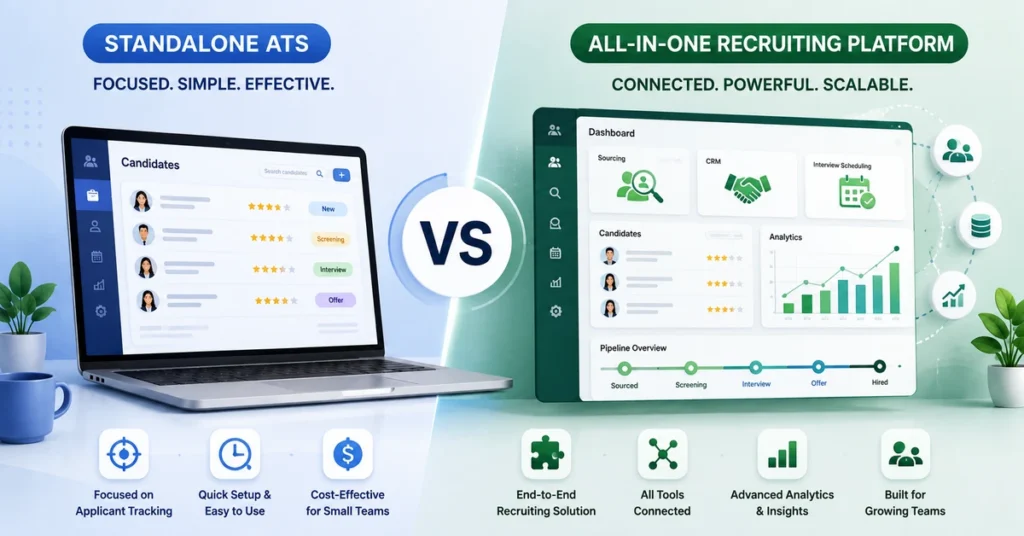


“Standalone” and “all-in-one” show up constantly in ATS marketing, and they describe a real, meaningful split in how recruiting software gets built. A standalone ATS does one job: manage candidates from application to offer. An all-in-one platform bundles that same tracking function together with sourcing, candidate relationship management, interview scheduling, and analytics, built natively into one product rather than connected through integrations.
This is a different question from whether to add a separate CRM tool on top of an ATS a business already has. That’s a decision about a second piece of software. This is about which architecture the ATS itself should have before buying it in the first place.
What Makes an ATS Standalone vs. All-in-One
A standalone ATS is built around a single core workflow: post a job, collect applications, screen candidates, move them through interview stages, and extend an offer. Everything in the product supports that one process.
An all-in-one platform, sometimes called a unified recruiting platform or a recruiting operating system, adds native modules for sourcing outbound candidates, managing longer-term candidate relationships, scheduling interviews across teams, and reporting on hiring performance, all built on the same underlying data instead of connected through integrations.
According to recruiting software company Bullhorn, the recruiting software category actually splits three ways: standalone ATS platforms, ATS functionality embedded inside a broader HRIS or HCM suite, and industry-specific tools built for a single vertical like staffing. All-in-one platforms are a newer variant of that same split, one that layers CRM and sourcing directly into the ATS instead of into an HR suite.
Standalone ATS: What It Is and Who It’s For
Standalone platforms, including BreezyHR, JazzHR, Workable, and SmoothHiring, are built primarily around inbound applicant management. Most include enough basic sourcing and candidate database functionality to be useful, job board posting, a searchable candidate history, but they aren’t trying to replace a dedicated sourcing or relationship management tool.
The appeal is focus. These platforms are typically faster to set up, less expensive, and easier to train a small team on, since there’s less surface area to learn in the first place. For a business that posts a role, screens who applies, and hires without much proactive outbound sourcing, that focus is a feature, not a limitation.
All-in-One Recruiting Platforms: What They Add
Lever, Ashby, and Greenhouse represent three versions of the same underlying idea: build sourcing, CRM, and analytics directly into the ATS instead of leaving that as a gap the buyer has to fill with separate software.
Lever markets itself explicitly as an ATS and CRM combined, branded as LeverTRM for talent relationship management, and holds roughly 8% of enterprise ATS market share on the strength of that positioning, according to HR-tech analyst Ongig. Greenhouse ships a CRM module alongside its core ATS for a similar reason.
Ashby goes furthest. It combines Applicant Tracking, sourcing, CRM, interview scheduling, and analytics into what its own marketing calls a recruiting operating system, built for scaling teams. By its own description, it is not a basic ATS for occasional hiring.
The shared logic across all three: when tracking, sourcing, and relationship data live in one system instead of being stitched together through integrations, reporting and AI features can draw on the complete candidate journey instead of a partial view.
Standalone vs. All-in-One at a Glance
Standalone ATS All-in-One Platform Core focus Applicant tracking only ATS + sourcing + CRM + scheduling + analytics Example vendors SmoothHiring, BreezyHR, JazzHR, Workable Lever, Ashby, Greenhouse Typical setup time Days to a few weeks Weeks, often with onboarding and configuration Best fit Reactive hiring, roughly under 20 to 30 roles a year Proactive sourcing, dedicated recruiting headcount Typical cost Lower, often per-seat SMB pricing Higher, frequently enterprise-tier pricing Main risk Outgrowing it as sourcing needs increase Paying for modules that go unused
The Real Tradeoff
| Standalone ATS | All-in-One Platform | |
|---|---|---|
| Core focus | Applicant tracking only | ATS + sourcing + CRM + scheduling + analytics |
| Example vendors | SmoothHiring, BreezyHR, JazzHR, Workable | Lever, Ashby, Greenhouse |
| Typical setup time | Days to a few weeks | Weeks, often with onboarding and configuration |
| Best fit | Reactive hiring, roughly under 20 to 30 roles a year | Proactive sourcing, dedicated recruiting headcount |
| Typical cost | Lower, often per-seat SMB pricing | Higher, frequently enterprise-tier pricing |
| Main risk | Outgrowing it as sourcing needs increase | Paying for modules that go unused |
The Real Tradeoff
The case for all-in-one is real, but it comes with a condition attached. The value only shows up if a team actually uses most of what’s bundled in. Ashby’s own product documentation notes that teams using it for tracking alone, while relying on outside tools for sourcing or scheduling, don’t get the full benefit of features built to draw on data across the whole platform. Paying for an all-in-one platform and using a third of it is a worse outcome than buying a focused tool built to do that one third well.
The case for standalone comes with its own condition. It works cleanly until proactive sourcing becomes a real, ongoing part of the job rather than an occasional task. Past that point, a standalone ATS paired with a separate CRM tool starts to look like more total complexity than a platform that had sourcing built in from the start.
Which One Fits Your Hiring Stage
Choose standalone if: you’re filling under roughly 20 to 30 roles a year, hiring is reactive (post, screen, hire), and no one on the team sources candidates proactively as part of their job.
Choose all-in-one if: you have someone whose job includes proactive sourcing, you’re hiring across multiple teams at once, or you want a single system of record for reporting across the full funnel.
Stay cautious either way if: you’re not sure which category you’re in yet. A standalone tool with room to add integrations later is a lower-risk starting point than an all-in-one platform you end up using a third of.
Is This the Same as Deciding Whether You Need a Recruiting CRM?
Not quite, and the two questions are easy to conflate. Whether to add a recruiting CRM is a question about adding a second tool on top of the ATS a business already has. This is a question about which architecture the ATS itself should have before buying it.
A business that decides a dedicated CRM isn’t worth the cost yet might still reasonably choose a lightly-bundled ATS over a completely bare-bones one, since built-in candidate pools and light sourcing tools cover most of what a small business needs without a second subscription. For the full breakdown of when a dedicated CRM actually pays for itself, see our guide on whether a small business needs a recruiting CRM.
Frequently Asked Questions
What’s the difference between a standalone ATS and an all-in-one recruiting platform?
What’s the difference between a standalone ATS and an all-in-one recruiting platform?
A standalone ATS focuses only on managing candidates after they apply. An all-in-one platform adds native sourcing, CRM, interview scheduling, and analytics built into the same product rather than connected through separate tools.
Is Lever a standalone ATS or an all-in-one platform?
All-in-one. Lever markets itself as LeverTRM, an ATS and candidate relationship management system combined, built around sourcing and long-term pipeline nurturing rather than tracking applicants alone.
Do small businesses need an all-in-one recruiting platform?
Usually not right away. Most small businesses making under 20 to 30 hires a year without dedicated sourcing staff get more value from a focused, standalone ATS than from paying for sourcing and CRM modules they won’t use.
Does choosing an all-in-one platform mean I don’t need a separate CRM?
Correct, that’s the point of the bundle. An all-in-one platform like Lever, Ashby, or Greenhouse includes CRM functionality natively, so there’s no separate tool to buy or connect.
What’s the risk of choosing an all-in-one platform too early?
Paying enterprise-tier pricing for sourcing, CRM, and analytics modules a small team doesn’t have the hiring volume to use yet. The tools go underused, and the cost doesn’t scale down to match.
Conclusion
Standalone and all-in-one aren’t a better-or-worse split. They’re built for different hiring patterns. A standalone ATS fits a business that posts roles and hires from who applies. An all-in-one platform fits a team that’s sourcing proactively enough to need CRM, scheduling, and analytics living in the same system as the tracking itself.
Match the architecture to how hiring actually works today, not to where it might be in two years. For a full walkthrough of the buying process once you know which category fits, see our complete guide to choosing an applicant tracking system.