
Two finalists for the same sales role. Same years of experience, nearly identical close rates at their last job, same energy in the interview. The hiring manager broke the tie with a fifteen-minute personality assessment. Six months later, one of those hires was still on the team and the other wasn’t, but nobody could say with any confidence that the test had predicted which one would work out.
That’s the honest state of personality testing in hiring today: genuinely useful in some situations, genuinely overused in others, and rarely explained clearly to the people deciding whether to add one to their process. This guide covers what personality tests in hiring can actually tell you about a candidate, what they can’t, the legal and practical risks worth knowing before you build one into your funnel, and how to use one without leaning on it too hard.
What Is a Personality Test in a Hiring Context?
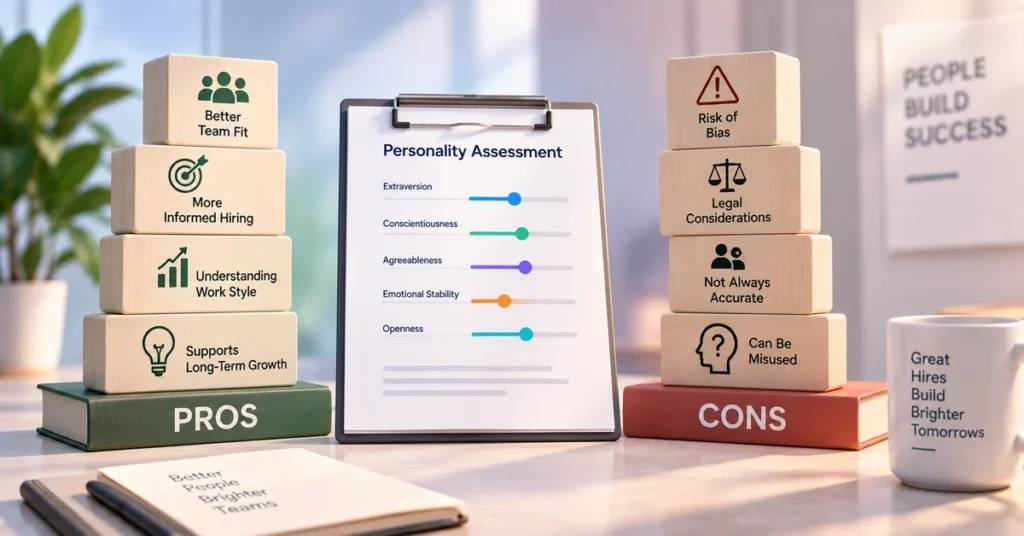
A workplace personality assessment is a self-report questionnaire that asks candidates to rate how well certain statements describe them, then scores their answers against defined trait categories. The most common frameworks in hiring today are built around the Big Five model (openness, conscientiousness, extraversion, agreeableness, and emotional stability), along with proprietary tools like DISC or Predictive Index that group people into behavioral styles.
Myers-Briggs-style typing (the kind that sorts people into 16 letter combinations) is still popular in team-building workshops, but most industrial-organizational psychologists don’t recommend it for hiring decisions. It sorts people into fixed types rather than measuring traits on a spectrum, and its results aren’t as consistent from one test attempt to the next as the frameworks built specifically for employment use.
Why Employers Use Personality Assessments
Most companies reach for a personality test for one of a few reasons:
To predict how someone will approach the day-to-day demands of a specific role, like whether a naturally reserved person will thrive in a role built around constant cold outreach.
To build a more balanced team by understanding what mix of working styles already exists and what might be missing.
To reduce pure gut-feel hiring by adding at least one standardized, consistent data point across every candidate.
To support onboarding and management once someone is hired, not just the initial hiring decision.
The Pros: What Personality Tests Do Well
They add consistency across candidates. Every applicant answers the same questions in the same format, which is more standardized than an unstructured interview where each candidate gets a different conversation.
They surface work-style differences a resume can’t show. Two candidates with identical job titles and responsibilities can have very different approaches to conflict, ambiguity, or pace of work. A resume won’t tell you that. A well-built assessment can at least raise the question.
They reduce the halo effect from a strong interviewer. Charismatic candidates often interview better than they perform, and a personality tool that isn’t swayed by charm can act as a useful counterweight to a panel that’s impressed for the wrong reasons.
They’re useful beyond the hiring decision itself. A candidate’s results can help a new manager understand how to communicate with them, delegate to them, and set them up well in the first few months, which is arguably where this kind of data adds the most value.
The Cons: What Personality Tests Get Wrong
Self-report bias is real. Candidates know they’re being evaluated, and most will (consciously or not) answer in the way they believe looks best for the role, a well-documented pattern called social desirability bias. This doesn’t make the results useless, but it does mean the score reflects how someone wants to be seen as much as how they actually behave.
They’re weaker predictors of job performance than people assume. Personality measures generally show a looser link to actual job performance than structured interviews or cognitive ability testing, particularly when a personality score is used on its own instead of alongside other signals.
They carry legal risk if not chosen carefully. A trait requirement that isn’t clearly tied to the job can unnecessarily exclude qualified candidates, including some with disabilities protected under the ADA. Any assessment used to screen candidates should be evaluated for job-relatedness, and it’s worth involving employment counsel before rolling one out at scale.
Overreliance leads to bad decisions. Rejecting an otherwise strong candidate because one trait score fell outside a preferred range treats a single data point as more definitive than it is.
Not every framework was built for hiring. Tools designed for team-building or personal development, like typology-based tests, weren’t validated for employment decisions and shouldn’t be used to screen candidates in or out.
Personality Tests vs. Other Assessment Types
Assessment Type What It Measures Best Used For Predictive Strength for Job Performance Personality test Traits and work-style preferences Fit conversations, team composition, onboarding Moderate, stronger when combined with other tools Cognitive ability test Reasoning and problem-solving Roles requiring learning, judgment, or complex problem-solving Strong across most roles Structured behavioral interview Past behavior in specific situations Evaluating how someone has actually handled real scenarios Strong when questions are consistent and well-designed Skills/technical assessment Job-specific competence Roles with a clear technical or practical skill requirement Strong for the specific skill being tested
How to Use Personality Assessments Responsibly
| Assessment Type | What It Measures | Best Used For | Predictive Strength for Job Performance |
|---|---|---|---|
| Personality test | Traits and work-style preferences | Fit conversations, team composition, onboarding | Moderate, stronger when combined with other tools |
| Cognitive ability test | Reasoning and problem-solving | Roles requiring learning, judgment, or complex problem-solving | Strong across most roles |
| Structured behavioral interview | Past behavior in specific situations | Evaluating how someone has actually handled real scenarios | Strong when questions are consistent and well-designed |
| Skills/technical assessment | Job-specific competence | Roles with a clear technical or practical skill requirement | Strong for the specific skill being tested |
How to Use Personality Assessments Responsibly
Validate the tool against the specific job, not just the general idea of “we want a strong communicator.” Whoever selects the assessment should be able to explain exactly why each trait it measures matters for the role.
Never use it as the sole disqualifier. A personality score should sit alongside a structured interview and, where relevant, a pre-employment assessment model, not replace either one.
Tell candidates what it’s for. Being upfront about how the results will and won’t be used builds trust and tends to reduce the incentive to game the answers.
Audit for adverse impact regularly. Check whether the assessment is disproportionately screening out candidates from any protected group, and adjust or drop the tool if it is, regardless of how useful it seems otherwise.
Train hiring managers not to over-index on one trait. A single lower score on one dimension shouldn’t outweigh a strong resume, a strong interview, and a strong reference.
Loop in legal or compliance review before scaling up. This matters more the larger your candidate pool gets and the more consistently the assessment is applied.
How SmoothHiring Supports Better Assessment Decisions
Personality data is most useful when it’s one input among several, not the whole picture. SmoothHiring’s tools let you combine work-style insights with role-specific skills and reasoning tests inside a single Applicant Tracking System, so a candidate’s full profile stays in one place instead of scattered across separate vendor dashboards. Paired with Predictive hiring models built on actual performance data rather than trait scores alone, hiring teams get a more complete, better-balanced read on fit before making an offer.
Frequently Asked Questions
Are personality tests legal to use in hiring?
Are personality tests legal to use in hiring?
Yes, but they need to be job-related and validated to avoid disparate impact concerns under U.S. equal employment law. Employers should confirm any assessment they use has been evaluated for adverse impact and consult legal counsel before using it at scale.
Can candidates fake their answers on a personality test?
To some extent. Most candidates unconsciously shade their answers toward what they think looks favorable, a pattern known as social desirability bias. This is one reason personality results work better as a conversation starter than a hard pass/fail filter.
What’s the difference between a personality test and a cognitive ability test?
A personality test measures traits and work-style preferences, like conscientiousness or sociability. A cognitive ability test measures reasoning and problem-solving skills. They’re testing entirely different things and are strongest when used together, not interchangeably.
Should personality test results ever disqualify a candidate outright?
Generally, no. A personality score is one input among several and shouldn’t override a strong interview, relevant experience, or a solid reference check on its own.
How do I know if a personality assessment is causing adverse impact?
Track pass-through rates by demographic group at the stage where the assessment is applied. If one group is being screened out at a meaningfully higher rate than others, that’s a signal to review the tool, the cutoff score, or how it’s being weighted in the decision.
Do personality tests help after someone is hired, not just during hiring?
Often, yes. Many teams find more value in using the results for onboarding and management, helping a new manager understand how to communicate with and delegate to a new hire, than in using them to screen candidates in the first place.
Conclusion
Personality tests in hiring aren’t a shortcut to better hires, and they aren’t useless either. Used well, alongside a structured interview and role-relevant skills or cognitive assessments, they add a genuinely useful layer of insight into how someone works, not just what they’ve done before. Used alone, or used to justify a decision that’s already been made for other reasons, they create legal exposure and screen out people who might have been strong hires.
If you’re deciding whether to add a personality assessment to your process, start by getting clear on exactly what trait matters for the role and why, then build it into a broader evaluation rather than treating it as the deciding factor. Take a look at how SmoothHiring’s Platform fit alongside structured interviews and predictive scoring, and to see the full picture in action.